Showing posts with label Lab Drama. Show all posts

Saturday, November 9, 2013

Two College Kids Messing Around in a Morgue - Ruh Roh!

As young adults you, me, we all did dumb stuff from time to time...
 

Like the time a friend and I went down steep-steep Cotton Tail Road on our skateboards with no helmets or safety gear and crashed hard resulting in many inches of road rash and near concussions.  My head bleeding, my forearms looking like chop-meat, I then proceeded to drive us both home stopping at a convenience store for a soda.  The store owner nearly called the police on us.  Ah - those were the days.

You would think that working in a clinical laboratory, safety is a main concern and for the most part that is true.  But, when the manager tells two young lab assistants to dump some old chemicals down the sink, well mayhem can and will ensue.   This is the tale of what happens when critical thinking skills are not applied to a situation and great danger can overcome the festivities.

The word "old" is just a useless adjective when attached to the word "chemicals".  Chemicals in pure form should always be handled with a clear head and proper protective equipment.  Old chemicals can diminish in reactivity but still remain quite concentrated and active enough to cause bodily harm, damage, and other dangerous risks.

And so the story begins with a request from the lab manager of his young minions; "Take these boxes of old chemicals and dump them down the morgue sink - But be careful.  See photo below taken by Photographer Brandon Merkel of the laboratory morgue some 20+ years later.  We were working part time in a mental health facility laboratory with over 100 years of history.  Some of the chemicals were real old. But, you see we were educated, college trained, young, and rather invincible in our own minds.  So this was going to be an easy work day Right?
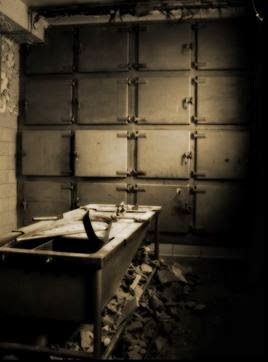
Photograph by Brandon Merkel

Well nothing was farther from reality.  I agreed to take the first few hours and my cohort would take over after I left for the day.  I proceeded to sort jars of chemicals by my own self starting relevance by recognition.  If I recognized the name of the chemical I opened the jar and poured it into the drain followed by copious amounts of water.  For the most part I was OK.  I had gloves, lab coat, and goggles covering my eyes.  Luckily, I was only working a 4 hour shift.  One chemical at a time followed by water, I was having good luck.  I was careful not to mix the chemicals together in the drain.  On and on it went.  No incident and no drama for me. Then it was time to leave for the day to attend my evening college classes.  My cohort took over.  He thought he was invincible too.  Unfortunately, he was not.  Critical thinking was not present in his work.  Instead of dumping - rinsing - waiting - repeat; his work flow was more streamlined.  He Opened several jars randomly grabbed out of the box, poured into the sink, after a scary amount of chemical was present water was added to rinse down the drain.  Well, under such a routine it was only a matter of time before disaster was at hand.  Several chemicals mixed together producing a cloud of dangerous noxious vapors which overcame my cohorts senses and eventually his faculties.  When he fell to the floor luckily he knocked down a box of chemicals and made enough of a ruckus that other laboratory staff heard and came to investigate what happened.  They pulled my cohort to outside air, opened doors and windows to release a eye tearing, breath stealing vapor cloud from the morgue.  My poor cohort almost bought it in the most ironic of places - right next to the morgue table.  What a disaster.  My cohort was alright though a temporary leave of absence was in order for the poor kid.  He was lucky that day.  So what have we learned?  Chemicals are dangerous.  Mishandling them is deadly.

As laboratorians working with various chemicals on a daily basis we are trained how to properly handle chemicals, how to mix them, and how to dispose of them whether in pure or aged state or post use.  This is all very good to know. But what about at home? Should we be concerned about household chemicals present in our living spaces?  The answer is an emphatic YES.

Here is a brief list of do's and don'ts for chemicals around the house.

Keep chemicals in original containers.
Date opened chemicals so you can keep track of their age, use, and reactivity.
Do not mix chemicals together.
Follow "How To Use" instructions directly on the label without deviation.
Discard empty containers.  Do not use empties for storing or preparing other chemicals.
Acquire MSDS forms for the cleaning chemicals you have in your home from the manufacturer; for example SC Johnson. 
If you purchase concentrated cleaners and mix with water also purchase generic non-labeled application containers or sprayer bottles for such use.  Mark the container with exactly what is contained and at what concentration.  Date the container with the date of preparation.  In the event of an accident with the chemicals, a spill, or splash in the eyes it is important to know what exactly the chemical compound is.
In the event that a child has exposure to the chemicals, it is critical to know and be able to calmly tell
poison control what chemical and at what concentration the exposure happened with.

Don't;
Mix different chemicals together - Cleaning a toilet bowl then spraying the seat with a chlorine based cleaner can result in deadly vapor production.  In the enclosed confines of a small bathroom you could wind up on the floor in trouble.  Some chemical compounds are heavy and thus hover the floor so your head on the floor is a bad place to be!
Don't;
Use old containers for preparing new cleaning solutions.  They are not properly labeled and the initial mix  of solutions may not work as expected or may be dangerous to handle.  An exposure at some later time may lead to erroneous information given to poison control in an emergency resulting in further harm or death to the affected individual.

Never: Mix chlorine based chemicals with ammonia based cleaners.  This is a recipe for quick
illness and death.
Never: Mix drain cleaners with anything other than water.  Use rubber gloves when handling drain cleaners, oven cleaners, or anything labeled as "Caustic".

The most dangerous chemical compounds you can purchase without special permits is by far caustic drain cleaners and concrete scrubbers (Acids). Absolutely, Do Not mix these together and it is against the law to use these products in a way deviated from intended use as per the product labels.


Don't be stupid my friends - use your critical thinking skills.  Chemistry is wonderful when used properly.
Please click through links below to important information concerning the safe handling of chemicals in the home...

OSHA.gov
American Assoc of Poison Control Centers
National Capitol Poison Center
US Chem Safety Board
Guide to Chemical Hazards

Brandon Merkel is a photographer on Long Island NY.  Permission was granted by Mr. Merkel to use the morgue picture above.  The picture was taken some 20+ years after this story took place in
Sept. 1981.  The morgue autopsy table is shown slightly out of original position and plumbing fixtures are missing in the photograph.  The 16 square doors oriented floor to ceiling are the morgue refrigerator.  I observed an autopsy in this morgue room.  This room was located in Building 23, Pilgrim Psychiatric Center, Brentwood, NY.  The predominance of the ground floor was clinical laboratory which I worked as lab assistant for 6 months until Jan. 1982. There are multiple pictures to be found on the internet taken in this morgue but show the condition of the refrigerator in various stages of disarray and destruction.

Scott R. Mayorga A.A.S., BS MT(ASCP)H CLS


Monday, August 19, 2013

Name that Organ! Adventures in Autopsy Science


During my employment as a Lab Assistant while attending school for my bachelor's degree in Medical Laboratory Science, I was lucky and intrigued enough to assist the Laboratory Pathologists with assigned autopsies. I was employed by State of New York Dept. of Mental Health, Clinical Laboratory division as a entry level Lab Aide. Among the various duties assigned to me this was the most interesting and uncommon for a student in between degrees. I studied Anatomy and Physiology in early college and believe me there is no better refresher course than assisting the autopsy with a Pathologist. Over the time of my employment at Dept. of Mental Health, I assisted with about a dozen autopsies. At first the experience is very unpleasant, daunting, and well just gross! The smell of a dead body is horrific. Up close and personal to the subject matter is very tough to handle. With regard to odor, some autopsies were worse than others. Depending on how long post-mortem the autopsy was performed. One thing that never got better was the smell recollection. Even though I worked part time, ran to school for classes late day and evening at college, the smell recollection would linger for several to many hours. Sitting in class I thought I was next to the autopsy table.

The Autopsy: Subjects as I will call them aka “the stiffs”, patients, customers? Would be brought out of the morgue to the table. I would need help from another lab assistant or Lab Tech moving the body from the morgue tray to the gurney and then to the autopsy table. Once on the table, a rubber block would be wedged under the neck of the body to support the head; that was important because you did not want a floppy head when the bone saw was applied to the skull. At this point readers if you are squeamish or affected by gruesome details of cutting up a body into chunks then you should click the red X now and vacate this post. You have been warned. An autopsy is performed to make determination of how a person died and/or the reason a person expired. The patients housed at Dept. of Mental Health were psychiatric patients. The patients who were autopsied died at the facilities. I do not know why autopsies were performed other than concerned family members of the deceased wanted to know.

Once placed on the autopsy table any bed linens covering the body were removed. Tools of the trade were arranged on a rolling table beside the autopsy table. The bone saw was plugged in and at the ready. Before moving the body from morgue to table, PPE was donned. PPE is known as personal protective equipment which included a disposable lab coat, shoe covers, and gloves. Once the autopsy process started, I placed a full face mask on my head. Depending on the Pathologists preference either he would start at the head or the body cavity upper chest. Most times I assisted, the Pathologists started at the chest and ended at the head. This accomplished two things to save time. Working the body cavity first allowed the Pathologists to complete work there so I could start with my tasks while he worked on the skull. Basically, the process was a search and biopsy adventure with any apparent pathology necessitating additional biopsy specimens, organ chunk collections, and or fluid collections. Gruesomely, a long incision was made at the top of the sternum continuing down the chest ending to about just below the navel area. A horizontal cut was made just under the breast tissue creating a giant T cut into the trunk of the body. Once the flesh was peeled away to expose rib cage, the bone saw was grabbed to cut through the bone of the cage. The idea was to remove the rib cage like it was a vest to expose all the organs underneath. Once the organs were visible that is when the lesson sometimes started. Pathologists would point and ask “So what is that organ? I would answer heart! He would then follow up with Yes – but which side of the heart is that? Then he would explain the architecture and function of the heart. Moving on to asking about the liver, and then the lungs I would get a visual up close anatomy lesson. Then some of the more obscure organs like spleen, upper intestine, and all those “female parts”. You know what they say down at the auto-parts store...Parts is parts! Once the geography lesson was over it was back to business at hand. Organs were removed one by one systematically layer by layer. On the autopsy table was a cutting board. That is where whole organs were placed measured, sliced, cut, and then chunks removed for analysis. The pathologist would slice up the heart into its four functional chambers carefully removing pieces that would eventually be processed onto glass microscope slides. It was a methodical process; each organ would be removed from attaching blood vessels and connective tissue, weighed on a scale in grams, measured in centimeters, then cut on the board. From there the organ went into a large plastic bag. Each organ would wind up in the bag after weight and size measurements and samples taken. Once the organs were removed from the body cavity, pieces of the spinal column were removed as well. Reproductive organs would be last to come out of the cavity. Breast tissue was removed from females, testes removed from males.  Each organ was inspected carefully to look for signs of disease.  Sometimes heart disease, liver disease, lung disease was apparent as well the effects of years of smoking.  Stomach contents would be inspected and sometimes the contents looked like what you might find in an old coat pocket; coins, paperclips, screws, pebbles, and whatever else that patient decided what non-nutritional item was on the menu.  After the organs were analyzed and sampled then the Pathologist moved onto the skull and thus the bone saw was revved up.  This grizzly device as seen above made a raucous racket and ear deafening screech while just turned on.  When cutting through bone the noise created was muffled slightly by the medium at which it was applied; skin tissue, bone, and brain matter within the skull.   Of all the procedures performed during an autopsy this was by far the most gruesome and shocking visually to observe.  Strategic cuts in the skin framing the forehead were made first so the skin could be peeled back to expose bare skull.  Then the bone saw would be applied to cut through the skull.  The bone saw blade would oscillate back and forth rapidly with jagged teeth that would cut through the skull with a ferociousness like no one has seen before.  Surprisingly, for so much racket and blade oscillation there was not alot of mess kicked up? Anyway - Might I digress... Once the skull was cut, the cap was removed to expose the brain.  Upon inspection of the brain it was apparent in some of the oldest of the older patients that someone had been there before removing brain matter.  Usually, there was a drilled hole in the skull that gave a clue that the patient was not all there literally.  The brain was then removed, measured, weighed, and samples were taken.  Sometimes the brain was kept and sometimes it was replaced back to its nest.  All the Pathologists either replaced or kept just depending on the case at hand and what was found in the autopsy process.
After the finding and exploration was complete then it was time to "tidy up".  With a big sewing needle and cord all of the cut skin was sewed back together.  I have done sewing by hand before to repair a shirt, torn seem, or replace a button but nothing like this.  All the pieces were sewn back together.  Oh, and that bag of organs...that was placed back in the body cavity.  Parts is parts you know!  Anyway, I wanted to give a first hand experience into postmortem analysis via the Medical Autopsy which is quite different than the Forensic Autopsy.

There were some antics played out though...I have great respect for Pathologists.  These are the folks who discover what has caused death of our loved ones.  Pathologists also determine how death came about in criminal cases.  Pathologists run the clinical laboratory, hold the license issued for lab operation from local State Governing bodies, and also hold the CAP (College of American Pathologists) certification that all clinical laboratories strive to maintain every year.  But, some Pathologists are wacky, some are funny, and some just carry around morbid humor.  Once such wacky experience I had with a Pathologist while assisting the autopsy was a shocking incident.  This Pathologist was busily trying to cut some bone from the spine on a patient when he slipped with the scalpel blade and jabbed his finger.  A gloved hand is not going to keep a sharp blade from penetrating so when he pulled his hand out of the body he was working on and pulled off the glove, blood was spurting and dripping all over the floor.  He rinsed his hand in the "clean" sink, wrapped his finger with gauze tightly, gloved up again and continued on.  Some expletives were uttered in a foreign language I am sure of it, but he carried on till the end.  With another Pathologist on another case, the good doctor came into the morgue smoking a cigarette.  With the body on the table, tools all laid out, he puffed on his cigarette, said "lets get started", placed the cig on the edge of the autopsy table, and began his work.  He picked up that cigarette a couple of times for a puff while engrossed in autopsy work. That was wacky!  By far the saddest cases I observed were the patients that had holes drilled in their skulls with very apparent sizable brain matter missing usually from the front of the brain.  The procedure carried out on these patients was called a Frontal Lobe Lobotomy.  It was thought years ago that removing certain regions of the brain of a person exhibiting crazy behavior might just curb that behavior and make the patient more docile.  Maybe some of our prominent government figures could benefit from such a procedure to help them cope with the daily grind of "political mishaps"?  Anyway - might I digress?

The adventures I experienced as a young laboratory scientist in the morgue were a valuable cache of knowledge and life experience.  Don't knock it.  The autopsy process has been brought to the headlines of today's newspapers and TV news.  It is gruesome but a necessary part of medicine we all benefit from.  It is a great learning experience to observe an autopsy.


Saw Photo Courtesy of Dr. Ed Uthman 

Take care friends.  Be well and be happy.

Scott R Mayorga  A.A.S., BS MT(ASCP)H CLS

Monday, May 27, 2013

Officer Tuthill-Incomming

One of the most dramatic laboratory stories I can ever tell occurred on May 27, 1986.   Officer Tuthill was a police officer for the Suffolk County Police Department; Long Island New York.  This brave officer was shot point blank by an angry motorist who he gave a summons to that evening.  The man shot officer Tuthill in the face with a 12-ga. shotgun.  Officer Tuthill survived his injuries but was permanently disfigured and blinded in one eye.

May 27, 1986, I was scheduled for evening shift at SUNY Stonybrook, University Hospital.  While driving to work in my 1982 Toyota Celica GT, I heard on a news radio station that a police officer was shot on eastern Long Island.  The officer was gravely injured and was en-route to University Hospital.   I new then that my shift was going to be busy in the lab.  I continued on my usual commute from Copiague, NY to Stonybrook.  Arriving at the hospital employee parking lot the atmosphere seemed quiet, normal, and like no action was going on.  I parked in a space on the lower level of this three tiered open lot and started up the stairs toward main level where the emergency room was located.  Once at the top of the stairs, I could turn around and look over the North-West horizon and see  a far distance as the hospital was on high elevation.  To the East was a line of tall trees that blocked the horizon. In the Easterly distance I could hear a familiar sound.  The low rumble of a helicopter was close and closing in fast.  As the sound became deafening, a monstrous, green, super sized National Guard helicopter cleared the tree line and made a tight radius turn right over my position.  This flying machine was gigantic.  It was the size of a bus with a massive rotor spinning with ferocious velocity.  In seconds the huge flying machine was on the ground and ER staff were running out to meet the tragic situation.  Officer Tuthill was quickly transferred  to a stretcher from the huge helicopter. I stood and watched the whole process of fly in, landing, transfer, ER entry, and then finally take-off.  The big huge bird with the massive rotor began to increase engine RPM.  The faster the rotor spun, the louder the noise.  I never heard anything so loud.  The smell of Jet-A exhaust was almost chocking.  As the rotor spun into a gray blur, the big bird slowly left the ground.  This great big flying machine turned in a hover about 30-40 ft above the ER parking lot and slowly rotated toward my standing position.  Flying directly overhead, I felt the power the rotor exerted in downward force on the atmosphere around me.  It was a feeling I may never experience again.  That close and underneath a roaring army helicopter was impressive, exhilarating, scary, and exciting.

I briskly entered the emergency room and headed toward the elevator to make my way to the lab.  There were lives to save in this large facility. As a trauma center, there were always lives to save.  I was ready to do my small part to help this medical team save officer Tuthill.  Arriving at the Hematology lab, all the staff were buzzing about the newest patient to arrive by helicopter.  Even though the lab did not have windows we could always tell there was a helicopter on the pad.  The ventilation system air intake was in close proximity to the helipad, so we always knew when a helicopter was present on the pad.  In short order,  first blood specimens arrived from  Officer Tuthill.  The lab was a torrent of activity to receive, process, analyze, and result the testing for this brave Officer.  Several more blood specimens would arrive in the lab that evening from Officer Tuthill.  His injuries described amongst the staff were grave and horrific, he was critical.  The next evening at University Hospital there were more specimens to analyze for the officer.  Little did I know then that the patient was on his way to not only making a recovery, he would also testify in court to tell the story of how the "perp" shot him in a supermarket parking lot.  Officer, Tuthill would move on through the years, returning to the police force as a Detective.  After 25 years, Officer Tuthill retired from Police Duty.

Although, very insignificant was my part in the saving of Officer Tuthill that evening, it was the collective efforts of the whole medical team that ultimately saved the patient.  The quick transport from the supermarket parking lot crime scene to the helipad at University Hospital was instrumental in getting Officer Tuthill much needed medical care ASAP.  A dedicated team of Doctors, nurses, and professional staff worked expediently that evening and fervently for the rest of Officer Tuthill's hospital stay to bring the best possible outcome for this brave man - returning home to his wife and children, then back to servicing the community on the police force.
God bless you Mr. Tuthill and your family.

Lab work is not always glamorous or exciting as this story contends.  The laborious efforts of Clinical Laboratory Scientists often go un-noticed, working in background to provide much needed analytical definitive data to help the physician diagnose and assess the medical condition of the patient.   Med Techs keep the laboratory system in good order, instruments running at their best to provide accurate reliable lab data.  Not all medical tragedies have a positive outcome such as this story but when they happen all involved feel that their small part in the success is not that small after all.

Hospital facilities in cities big and small all have various plans and procedures to handle different medical tragedy scenarios.  The hospital I work in now [Gwinnett Medical Center- Lawrenceville] was recently  recognized as providing expert care for stroke victims.  Many facilities are recognized for expert care and for great results in treating specialized medical needs.  Get to know your local hospital facility...find out what their specialties are.  Look them up on Health grades.You never know when you will need their services.

Good day my friends - take care of yourselves.

Thursday, May 16, 2013

Medical Science in the Morgue

When I say the word "Morgue" what does that word conjure up in your mind?  Gruesome places, dead bodies laying around, last nights evening news shooting victim, body parts, blood, fluids, stainless steel implements?  Maybe and sadly worse for those who have ever had to go to such a place to make an identification of a loved one this story  may be most disturbing to you.  For me, the Morgue was a work place.  Yes it is gruesome.  It is messy.  It is necessary at times to find out why exactly someone passes on.  In morgue terms it is called expiration and the patient has expired.
 I studied anatomy and physiology in college, parasitology, bio-chemistry, and all the clinical lab sciences.  Nothing could prepare me for what I experienced in the morgue.  Not even the frog, pig or feline dissection we had in A&P.

I was hired as a lab aide straight out of school.  Sporting an A.A.S. Degree in Medical Laboratory Technology I was ready to hit the lab bench.  When I was told part of my duties was to assist the Lab Pathologist with his or her autopsies, my jaw almost hit that bench.  I was scared.  I was intrigued.

During my career, I have assisted a Pathologist with probably about 10 Autopsies.  I was working for the State of New York Department of Mental Health at the time.  I was a Lab Aide at Central Islip Psychiatric Center.  I was part time because I was also attending LIU/C.W. Post to advance my studies and degree.  Arriving to work in the morning I never knew what to expect.  There was an autopsy schedule but the patients were not on it obviously, the Pathologist who was going to cover the procedure for the day was scheduled on it.  Me and my co-hort/co-worker were the assistants. 
There were many a day I just hoped there was not a pending autopsy to be done.  But, it was necessary, and we all took turns covering the need.  Although, the lab manager did pitch in sometimes, the lab aides were the chief helpers.  I got to help a lot almost 1 per month.  With thousands of patients in the mental health facility, many of them elderly, there was quite a great amount of activity in the morgue.

The morgue was bright but not cheery.  A wall of refrigerator, 12 hatch doors, all hiding a slide out metal tray the could hold the heftiest of deceased patient.  Opposite the wall was a wall of windows that would let in natural sunlight into the storage and morgue table area.  The table was stainless steel, typical of what you would see on TV police drama shows.  At the end of the table was a stainless steel sink with hoses that can be used to rinse "things" and the table.  Above the table was a scale used to weigh "things".  At the other end of the table was a cutting board, used to cut "things".  In a storage cabinet was the nastiest, most gruesome looking, horrific sounding device I ever had my hands on.  "The bone saw" was just a nasty device used to cut through bones like the sternum, spinal column, and skull.  That saw screamed and whined at such a loud sharp pitch it was frightening just to hold the  darn thing.  Fortunately, for me, I never had to use it during an autopsy.  My duties were assistant and as such I did mostly clean up, wrap up, moving, weighing, measuring, and observing everything.  The end of my duties for the day were to get everything back in order so the funeral director could remove the body without all the "stuff" falling, pouring, oozing out all over the place.
I would not call it fine stitching, but stitching skin flaps back together with a big bag of organs stuffed back into the body cavity? that was my specialty.

There were several autopsies that stand out in my mind.  One had serious injury involved.  One had a querky Pathologist with ensuing antics around the table.  Two I found astonishing.  The Pathologist was telling during an autopsy that some of these mental patients will eat anything.  Glass, nails, thumb-tacks, bugs, pencils, anything they can get down their throat winds up in their stomachs.  This particular gentleman that we had in the autopsy room was quite hungry it seems.  When the doc opened up the stomach, low and behold there was a treasure of oddity to behold.  Coins, metal pieces form window locks, keys, and a short pencil.  Astonishing it was to see what this fellow ate and was stuck in the stomach.  At another time, an autopsy of a female patient was rather old...The pathologist told me of older times when patients would undergo the labotomy procedure or frontal lobe labotomy.  He told me these were gruesome procedures done under local anesthetic whereby a drill was used to drill a hole through the skull at strategic locations so that a surgeon could cut and remove brain tissue in hopes of improving the condition of the patient.  This poor female patient had three holes drilled through her skull.  Two were in close proximity at the upper-front part of the skull, but there was another larger hole in the skull almost at the back of the head.  It is terrible to think of what these patients must have gone through and endured in hopes of improving their condition in mental facilities all across the globe.  This patient also had sizable and obvious brain tissue deficit.

In today's world, many people need treatment but are afraid of the stigma of "Mental Health Condition" or these people are some of the homeless wandering the streets.  Years ago some people were held against their own will, formally committed to institutions of mental health.  I worked at two of those types of facilities early in my career.  These were dark, dreary, spooky institutional places.  But the staff were loving, caring individuals, highly trained to take care of those that could not take care of themselves.  We have more homeless today because a vast amount of these folks on the street really would qualify and should be taken care of in institutions.  Yes these facilities were not the greatest of places to stay and may atrocities were uncovered by media folks like Heraldo Rivera back in the 70's.  But we can do a better job in 2013.  We can better the care for those who cannot care for themselves now than rather than 30-40 years ago.  Unfortunately, these days it is all about the almighty dollar.  Trillions of American dollars are spent each year to support unworthy causes in far reaching terrorist laden lands; lest we overlook our own desperate needs  on our streets, in our shelters, and under roadway overpasses.

Be good to yourselves, take care of each other. It is rough out there.
My wife chided me for putting a picture of a young woman on my Pinterest boards and this particular female was sporting a trophy for the Worlds Largest Breasts; Guinness World Records.  I told my wife this lady represents the only thing that is good and wholesome in this dreary world we live in.

Be kind to those on the street.

Good day my friends.

Sunday, April 28, 2013

Standing Room Only

My 1st position as a certified Medical Technologist was on night shift at the grand St. Francis Heart Center in Port Washington NY.  


This was a famous 225 bed hospital devoted to open heart cardiac care on Long Island, NY.  Run and organized by the Catholic Archdiocese of NY, no expense was spared when it came to the pediatric wing of the hospital.  Then First Lady Nancy Reagan visited the facility to bring and introduce to America, two small children from South Korea who were undergoing open heart surgery to correct heart defect.  The operation was a success, Ms. Nancy was elated, the children went home to South Korea, everything was grand.  As grand as the doctors parking lot which was like a Starbucks on Rodeo Drive.  Ferrari, Mercedes, Jaguar, Aston Martin were all representative of the fine work the cardio-thoracic surgeons were performing everyday at St. Francis.

It was a hot summer night and one of those nights I did not look forward to at the Laboratory.  It was a solo night.  That meant after the evening shift left at 11:30 PM I was all alone until the 1st day shift techs showed up at 6:00 AM.  Yeh it was rough.  Managing workload between Hematology/Urinalysis, Chemistry, Serology, and BloodBank there was barely enough time to grab a quick bite to eat.  Upon arriving at the lab that evening I was informed that it was not a good day. The morgue was 75% filled to capacity.   You see, at St. Francis Hospital, it was a typical laboratory.

Located in the basement, down the corridor around the back of the cafeteria (Which closed at 7 PM) was the lab location.  Inside the confines of the lab was the "morgue".  The "morgue" consisted of a walk-in refrigerator that had room for 4 stretchers; 2 on one side of the door and 1 on the left side of the door, and one stright in, that's it period.  Starting out the evening with three stiffs on ice was not the usual at St. Francis.  However, the situation quickly got out of control.  Before the evening shift left for the night, "Nurse Ratchet" wheeled down stiff #4.  I signed the body into the "Morgue Book" and I informed the nurse "that was it - no more room".  "No vacancy at the Inn we are at 100%"  She said "Oh well? - my shift is done and I am on my way out - good luck".  Now this was a real nail biter.  In all my shifts, I had never before been at 100% morgue capacity.

Well, little did I know Mr. Cardiac Infarction was just pounding on the door to get in to the Inn.  After, about an hour of mundane lab work running the usual stat Chem7 and CBC's, checking the OR Schedule in bloodbank to make sure all was prepared, the phone rings.  It is none other than my favorite charge nurse, [Mr. Wiseass].  This charge nurse and I have had run ins before.  So, far I was 2/2 winning in the I was right - you were wrong - you are an idiot game.  Mr. Wiseass calls to tell me he has a patient that is being brought down to the morgue "as we speak".  I said "hold on there; I already have 4 bodies in a refrigerator that holds 4 stretchers - there is no room, no vacancy".  Wiseass tells me something so repugnant, so disastrous, so dysfunctional I could not believe my ears...Wiseass tells me ;"There is nothing I can do, the body is on the way down, you are going to have to double-bunk two bodies on one stretcher - maybe you can stand them all up instead?"  Well here goes 3/3..."No way - I will not allow that."  "You are going to have to call a funeral director and get them to come in and pick up a body now instead of later this morning".  Within an hour, one body was going out the back door and now there was room for Mr. Infarction at the inn.

ShareThis Post!