Showing posts with label Numbers. Show all posts

Monday, November 18, 2013

Biometric Scanning On Your i-Phone But Not at Your Local Hospital

So - you got a nice new i-Phone 5 equipped with that neat biometric scanner!  You can scan your finger tips, your nose, your toes, even your nipple will work to identify you to your new cell phone.  That is really cool.  You can even have your i-Phone open up to your spouse or significant other by scanning their appendages too.  Isn't it great how science betters our lives?

Why don't hospitals employ this now commonly available method for human identification in Emergency rooms and admitting offices?  I sure don't know why?  With the risks of health care fraud so great in today's dangerous world why would a hospital not employ this method to identify visiting patients? Let's explore the science of biometric scanning, how it works, and why this technology should be mainstream but is not.

My first exposure to biometric scanning was at the GA DDS - Dept.of Driver Services office when I applied for a drivers license in GA.  My finger was scanned at the office then I was issued my drivers license.  My next encounter with a biometric scanner was with my wife' Leslie of  Leslielovesveggies new i-Phone 5.  Now it is all the rage on that new Apple device.  No more remembering a pass code to open your phone.  Just swipe your finger, her finger, or my finger!  But, biometric scanning is not new.  The use of biometric scanning has been employed to identify humans and our pets for many years although identifying pets requires a chip implanted under the skin.  That is a big no-no for civilized humans.  However, humans have excellent physical traits that are perfect for biometric scanning such as finger print, vein recognition, eye recognition, palm scanning, on and on.  You name a part and it can identify quickly and noninvasively.  Biometric scanners for the finger or palm read the patterns in the skin and/or veins then archive the image in a database tied to your identity.  This method of identification is used all over the globe to open doors for employees, open safes for the rich, identify the sick at the hospital and the not so nice folks at the jail.

There is one country across the globe that uses biometric scanning practices to identify its population; India.  As of 2013 nearly 600 million people in that huge country have been identified in the largest database of its kind.  Countries such as Australia, Brazil, and Germany all use biometric scanning to identify its population to some degree.  So what is biometric scanning for the identification purpose?  It is the use of a scanning device capable of capturing distinctive attributes or traits selectively identifying a human being, storing those captured attributes in a database, with capability of matching scanned attributes to match identities.  Biometric scanning can use finger print, palm print, vein recognition, facial recognition, or iris scan.  The first time identity is established with biometric scanning methods is called "enrollment".  Identity is confirmed thereafter with verification which matches a scan against database knowledge to confirm identity.  Simple right?  Well not exactly.  Finger prints wear out, iris characteristics change, faces change and that can produce false reads or naive reads. With the development of more sophisticated multi modal systems false read rates can be eliminated.

So why if this technology is widely available, easy to use, and is non-invasive do so many health care facilities not use biometric scanning to identify patients?  Health care can be administered safely and accurately if we properly identified patients?  EHR or Electronic Health Record is so important to keep accurate but is so easy to become compromised, stolen, or abused.  Your EHR is worth hundreds of thousands dollars to the criminal element. Defrauding a hospital Emergency Room is not hard.  Hijacking your medical record and financial health information is not that much more difficult.  The only way to stop medical fraud is by positively identifying the patient.  So here is an example.  You have health insurance but your brother does not and he needs some acute treatment, maybe some stitches for a laceration or he needs antibiotics for a festering skin lesion right?  So he goes to the hospital that you have gone before recently.  He walks in with no ID but says he is Mr. SO&So Smith.  He arms his memory with his brothers SS# and some other background info such as his employment, address, telephone number.  Bingo! He looks like his brother, almost the same age, ba-da-bing he now is the brother.  Wam-Bam out the door discharged with treatment covered by his brothers insurance or worse Medicaid/Medicare. Don't think it happens?  I have a bridge at the western tip of Long Island for sale.  It is a steal at One Million Dollars - yeah that's the ticket....

Anyway, that is just one way how hospitals, doctors offices, clinics, and pharmacies are defrauded by health record hijacking and identity abuse.  The only way to stop it is by positively identifying the patient.  Estimates are as high as 28$ million per hour for health care fraud and abuse in the United States.  The FBI is in charge of investigating Health Care Fraud and has tips on prevention .  Their investigations in 2010 totaled up to $80 billion dollars in health care fraud.  The FBI has a long mugshot list [Mug Shots]of individuals wanted for Conspiracy to Commit Health Care Fraud.  With government health care spending poised to balloon into $Trillions per year the criminal element is just salivating at the chance to hijack your health record and set up criminal operations like none seen before.

Here is an example of how you can be a victim of Medical Identity Error resulting in financial harm. Suppose you are sick and go to the hospital for treatment.  You have been there before and you trust the care you will get.  The patient registration person gathers your identification and then finds you in the hospital database.  Your name is Jim or Jane Smith.  You know how many J. Smiths are in any given hospital database?  Well, your visit at the ER is matched up to J Smith alright, except he is James Smith, who is HIV +  and owes the hospital thousands of dollars in bad debt and unpaid bills.  Bingo, you now own James Smith' medical bills and a disease that is mandated to be reported.

Up till now I have just been talking about the financial risks associated with health care fraud deliberately perpetrated by criminals for financial gain or by error.  What about the "Medical Errors" that occur across this country on a daily basis?  Errors you say?  There are errors in health care?  Why yes. According to the American Association For Justice preventable deaths from medical errors average 98,000 deaths per year.  An error starting with patient identification can be deadly!
 Here is another example; Suppose your wife is ill and you take her to the ER.  She has been there before, they have a record of her because she is diabetic, and also highly allergic to certain preparations of insulin. The staff identify her and but register her under a medical record one number off of her true medical record number because of a data entry typo error on the keyboard.  In the ER she gets real bad and goes into Diabetic coma.  The doctor gives insulin but now your wife goes into anaphylactic shock because it is the wrong insulin. A few short minutes go by and your wife is in ICU, nearly dead, clinging onto life.  Hours go by and you think she is ok for the night so you go home for some rest.  Your awakened by hospital staff in the early hours to come to the hospital without any further explanation...

These are just a  few scenarios that could happen because of patient mis-identification.  Hospitals have a process whereby duplicate medical records are reconciled into one.  Sometimes when you visit a hospital ER the computer system is down for some reason so all patients are registered on paper record which is then entered into the computer database systems later.  You will be given a temporary medical record number until your visit can be reconciled to you historical records. This is called "MRN Merging". Not so bad if you truly do have a duplicate EHR and the two are merged together.  But what if the merge is incorrect?  Catastrophic consequences can be produced in some cases.  Your blood type can be changed, you can suddenly acquire a disease you never had before, or you can unexpectedly own debt that is not yours or your insurance company' responsibility.

So why do health care facilities not want to positively identify their patients?  There are less than 300 hospital facilities in the United States that employ biometric scanning to correctly identify their patients?  They may have the most expensive and sophisticated equipment on hand but will ask you who you are to identify yourself.  If you have picture ID use it but some people show up at the ER without ID.  The reasons why health care facilities do not use biometric scanning are:
  • $$$Expense - Biometric scanning Systems and the database management tools used to identify patients and relate this data to EHR is expensive.  Probably the most common reason this technology has not been adopted to main-stream health care practices.
  • Abuse of such databases has great financial enticement - the sale of such biometric identification data is a lucrative proposition for those who will have access.  However, the penalties for sharing PHI - Protected Health Information are steep and can include jail time for those found guilty of Health Care Fraud Conspiracy.
  • Civil Rights activists and privacy proponents hate anything that positively identify the population and store such identification in databases.

Well then, it is a two way street.  Maintain privacy but then risk acquiring the medical record of someone else.  Raise the level of health care safety at the expense of losing anonymity?

I would much rather be positively identified when it comes to serious medical treatment like surgery, pharmaceuticals, or transfusions than be mis-identified or have my medical record abused for financial gain by someone else.

What can you do to protect yourself..
  1. When you visit your doctor or most importantly a hospital make note of your MRN.  Next time you go back compare that number to any new registrations or visits to make sure the registration process identifies you properly.
  2. Carefully monitor EOB- Explanation of Benefits that you receive in the mail.  Report any inconsistencies to the hospital , insurance company, medicare (CMS), or your doctor.
  3. Carefully monitor your bank statements and credit card statements for any suspicious  or unknown healthcare charges and take action immediately if anything suspicious shows on a statement.
  4. Never give any personal information about yourself over the phone.  A "scammer" might get a hold of your name and phone number to call you asking about your last visit to a health care facility as a Customer Service Survey.  Hoping to gain additional information; you may be asked for this information directly on the call or purposely asked to verify incorrect info so that you can "Correct the Records".
  5. If you have a choice of hospitals to go to and one uses biometric scanning and one does not, go to the one with biometric scanning.  Tell the staff you came because they can positively identify you.
  6. Call your local hospital and request they start using biometric scanning for identification and that would make you more confident making a visit.

Good luck my friends.  Its a dangerous Health Care World out there.

Scott R. Mayorga A.A.S., BS MT(ASCP)H CLS

For more information on health care fraud  and biometric scanning click the links below.
NHCAA


Wednesday, November 6, 2013

Clinical Laboratory Licensing and Certification; What is the difference?

Laboratory Certification - Laboratory Licensing - What does it all mean?

 With over 239,000 clinical laboratory facilities registered in the US under CLIA - Clinical Laboratory Improvement Amendments; the public can get quite confused about regulations, certification, and licensing of these facilities.  Under CLIA, there are 29 different categories of Clinical Laboratories.  These can range from a mobile facility on wheels, health fares, hospital labs, and the mega reference labs performing millions of tests per year.  Various States operate licensing or permit programs of clinical labs.  The employees working the lab bench performing the testing of specimens are regulated by certification agencies and State level licensing via each locale.  So what is Laboratory certification?  What is the difference between certification and licensing?  Can a laboratory be certified but not licensed?  Can labs be licensed but not certified?  Can labs lose either certification or licensing and continue to operate?  I will try to answer these questions and explain concepts which can be confusing to laboratory consumers.  What is a Laboratory Consumer?  A lab consumer is you, me, the patient in general.  The doctor orders blood testing for us.  We go to a laboratory to submit specimens for testing, or the Doctor collects  specimens in the office and labs pick them up, or hospital staff come to your bed side to collect specimens.  Your specimens are received in a lab facility and tested.  Laboratory results are then delivered to the doctor who ordered your tests.  We are all consumers of lab testing facilities.  You do have a choice of who, what, where your specimens go for analysis.  What about that lab data?  What is a lab result?  What is lab data?  Laboratory data is the data produced within the laboratory from analysis of specimens; Unconfirmed data.  Clinical Laboratory Scientists test specimens by various methods and instrumentation.  Until that data is confirmed it is just that - data.  Once the data is verified as accurate and under control then the data is confirmed as laboratory results.  Lab results are then conveyed to the doctor for his or her evaluation.  This is a crucial concept to understand.  Lab data is subject to all sorts of regulations, guidelines, control, and evaluation before the data is declared laboratory results.  Just because a lab instrument issues numerical data does not mean that data is ready to be used to evaluate your medical condition or asses the health of an individual.  If quality control checks fail during the analysis of my specimen then the analysis is flawed and must be repeated and evaluated.  If my specimen does not meet guidelines for analysis then a new specimen must be obtained for testing.  Lab results are reported to our doctors.  Lab data is the unverified numbers or raw data issued by the testing method.  You nor I want lab data reported to the doctor.  We want verified lab results being perused by the doctor.

Laboratory licensing is sometimes synonymous with the Lab Permit.  Laboratories are a business.  Labs pay taxes to cities, states, and the federal government.  Various fees, registration fees, rent for building space, etc.  are paid by clinical labs.  A lab must have a permit to operate and test specimens.  Depending on the location of the lab facility a state permit is required and issued by the state department of health to the laboratory on an annual, bi-annual, or some other time period basis.  Renewal is required.  Some states also require inspection of the laboratory facility to maintain license or a lab operator permit.  To complicate the licensing issue, some specimens are collected from patients and transported across state lines or across the country to a central testing facility.  In those cases, the state where the specimens originate have jurisdiction over the performing laboratory no matter where the lab is located.  I personally know of a clinical laboratory that holds national certification but lost a state license due to revocation.  Even though this is a laboratory with quality processes, this facility is analyzing specimens without proper license from a state where samples are collected and jurisdiction is owned.  These lab results reported to physicians are reliable however there is great liability and risk if this facility where to be embroiled in a litigious process.  Basically, in absence of proper licensing laboratories are a risk to public health - especially when there is revocation involved.

Certification is the process a clinical laboratory under takes to gain prestige amongst other clinical laboratories and other competing laboratories; competing for our business.  Is certification of a clinical laboratory required?  No.  However, certification can be a supporting factor in the permit or licensing procedure of a laboratory.  Just depends on the licensing body of that facility.  Various organizations can certify clinical laboratories; the most notable is CAP - College of American Pathologists.   CAP certification is optional is some states or locales; however, that is a tricky road to embark on if you are a lab owner.  CAP certification is often inter-twined in the licensing procedure.  Just depends where the lab is physically located.  Hospitals can also be monitored/certified by JCAHO - Joint Commission on Accreditation of Health care Organizations.

CLIA Certification is different than lab certification described above.  CLIA certification is the permit or license if you will issued by the federal government so that a clinical laboratory can receive payment from CMS - Centers for Medicare and Medicaid Services.  A lab must be CLIA Certified to receive payments for testing specimens of patients enrolled in medicare or medicaid.

So, now that we know about laboratory certification and licensing what now?  Is this important?  Should a patient be concerned about these concepts when they visit their doctor for a check up?  The answers are yes, yes.  There are labs out there that either are not certified, not licensed, or have lost license or certification, or otherwise there is a lapse of one, both , or the other.  If there is a loss of either license or certification the big question is why?  Did the loss occur because of quality issues, performance issues, or some sort of regulatory infraction?  Either way, would you want your specimens used to screen your health analyzed by a laboratory that has lost certification or license?  I think not.  Do you feel comfortable bringing your car to Joe Smoe shade tree mechanic or your next door neighbor to fix your transmission?  No you don't and you would not do that.  You want someone who knows what they are doing and can prove it. The same with a clinical laboratory.  You want your specimens analyzed at a fully licensed, boastfully certified laboratory that can prove it 24/7/365.

But does a patient really have a choice where their specimens wind up to be tested?  Well sort of.  That depends on their doctor.  Some doctors have business relationships with clinical laboratories.  There is much federal regulation about this area of health care involving the prevention of kick-backs by labs to referring doctors.  The relationship is a loose agreement that the lab will pick up specimens and deliver medical reports to the doctor and may also provide supplies to collect specimens.  Anything more than that basic arrangement between doctor and laboratory and someone is going to jail.  There has been recent re-occurrence of kick-back payments by labs to doctors whereby thousands of dollars are passed to the doctor each year for the lab business from the doctor.  Prosecution of these cases has resulted in doctors going to jail for a long time.


However, you do have a choice where your specimens go.  When the doctor orders testing the order can be written on paper, or script.  You can take that script and go to any lab of your choosing.  You can do your own research and verify the certification and or licensing of labs and go to the one you are satisfied with.  Otherwise, you can let your doctor choose where the specimens go.

Be wise about your health care and be an informed consumer of health services.  Not all labs hold the proper license and certification to perform testing of your laboratory specimens.

To find a CAP Accredited Laboratory near you anywhere in the world click this link:
CAP
To find Laboratories that hold License with New York State DOH click this link:
NY State Clinical Laboratory Permit Holders
To find a licensed laboratory in Florida click this link;
Florida Laboratories
For more info about Laboratory Certification and certification of Clinical Laboratory Scientists
click this link; ASCP


Scott R. Mayorga
A.A.S., BS MT(ASCP)H CLS
Straight Talk From The Hematech

Monday, July 29, 2013

Lake Lanier Scientific Lab Analysis - Something Fishy Here but Not The Trout

I live within 15 miles of  Lake Lanier in the great State of Georgia.  Since moving here years ago there have been years of heavy rainfall and periods of drought and then there has been severe drought.  Unpredictable weather patterns bring rain or lack thereof over long periods of time. Yes it's the weather always changing as per God's will.  Recently, the lake has recovered water level from a record low level recorded in Dec. 2007. After several years of severe drought and mandated stringent water restrictions in surrounding counties supplied by the lake resources the lake recovery has been nothing short of astounding.  Following ample rainfall for the last two years the lake is now at full pool level and has been for some time now.  However, rain continues to fall from the heavens in ample fashion but the lake levels do not rise?  Why is that? One thing that is constant is the battle for control of the lakes resources and how much water is discharged down the river, the Chattahoochee that is.  The river and the prize possession that is Lake Lanier have been the center of hotly contentious court battles.  Using statistics easily available on-line I can show that something is fishy at the lake concerning lake level, rainfall, discharge at the Buford Dam, and the political football that is control of the lake resources by the surrounding states-Georgia, Alabama, and Florida.  All three states have stakes in this resource and the downstream monetary benefits of Lake Lanier.

Lake Sidney Lanier was constructed by building a dam in Buford GA on the Chattahoochee River in 1956.  Currently the lake encompasses 59 sq. miles.  After passage of an act of congress, appropriations were made to pay for the construction of the dam and clear land for the lake.  Once complete, the lake efficiently filled and in April 1964, a record high level was set at 1077 ft. above sea level.  Over the years, Lake Lanier has supplied water to surrounding counties and industry under the supervision of the Army Corps of Engineers. 

Year after year lake water levels are monitored.  Records are easily available for rainfall, lake level, discharge amounts, various quantities, time schedules, etc.   Because of the financial implications surrounding release of water from the lake and the monetary benefits reaped by downstream states like Alabama and Florida the issue has been publicized heavily, battles have been won in court to determine who should have access to this resource.  Most recently an impartial judge declared that Georgians do have the right to drink the water from Lake Lanier opposing the views of Alabama and Florida plaintiffs stating GA Residents have no right to and should immediately stop using water from Lake Lanier.  How ridiculous! Why in the world would there be an argument of denying Georgia communities access to the drinking water resource that is Lake Lanier so that business downstream could benefit more from the lake being emptied to nearly critical and historical low levels?  Why MONEY of course.  It's always the money.  Under a subterfuge of wildlife conservation and protecting endangered species the lake was almost drained dry in latter 2007.  Those screaming for more water downstream to protect wildlife were also selling such wildlife at market for a premium.  Hardly what I would call "wildlife preservation and protecting endangered species indigenous to wildlife areas". While Georgians who rely on the lake for drinking water not only embraced tough legal restrictions on usage also surpassed expected conservation targets while doing so throughout the recent drought conditions plaguing the Atlanta Metro and surrounding counties.   What did the downstream states do for conservation?  They brought the State of Georgia to court with hopes of having a Federal Judge rule that Georgians don't have a right to drink a glass of water from Lake Lanier and that all consumption should stop so that the lake located in the middle of North Georgia would solely supply water to fish and game industry in Alabama and Florida.  Arguments and court action brought forward by the surrounding states of Georgia to force the Army Corps of Engineers to increase release amounts are nothing new and have been going on for decades.  In 2005 the Army Corps upgraded measuring devices at the lake to determine what and when gets released through Buford Dam.  After the equipment upgrades were completed startling amounts of water were being released from the lake and anyone familiar with those discharges knew the amount released was too much.  After months of complaints from local residents around the lake and attention to the matter given by then GA Governor Sonny Purdue that too much water was being released, the Army Corpse finally re-calibrated the equipment.  Low and behold, releases from the dam were verified as too much by the Army Corpse but all was too late.  The record low level of the lake attained on Dec.26th, 2007 at 1050.79 was officially declared a man-caused disaster courtesy of the mis-calibration of the newly installed equipment.  Why did it take so long for engineers to realize the discharges were dangerously high?  The lake was at its lowest level in history; drought conditions in the region were getting real scary. After this man-caused disaster the lake did not recover for about 30 months.  What I am afraid of now is with the recent elevated rates of rainfall in the Atlanta region, lake levels are not increasing like one would expect.  Lake levels are remaining constant and set at a full pool of 1072 ft. above sea level.  The water[rain] has to go somewhere.  Obviously, Downstream industry is benefiting immensely but there is no publicity about that.  Like the rat stealing the cheese the rat shuns away from publicity for fear other rats will catch on to the windfall or the controlling interests will regulate restriction on industry much like communities had access restricted during drought conditions.  More about the impending water grab later.  Why not raise the lake level?  Why not squirrel away water for when there are not plentiful rainy days like there are now?  The downstream industry has an insatiable apatite for the water resource that is Lake Lanier and the Chattahoochee.  For the love of money, the lake could be drained dry and local residents would be bathing in FEMA supplied bottled water to the chagrin of the "endangered" Sturgeon and Muscle farmers downstream.  Lot's of rain and stable lake level are making for a tough denial of the fish farmers downstream.
Army Corps of Engineers? - Raise the lake level already! 
Here are my facts:
Rain fall in Atlanta Metro Region:
Time period: Jan. 2009 - June 2009

25.77" Rainfall
 Lake levels started recovery from record low level attained in 2007.

Lake Lanier water levels:
2009 Lake Level increased 12.88"
Jan. 2009  Lake Level = 1053.14 ft. (Above Sea Level)
June 2013  Lake Level = 1066.02 ft. (Above Sea Level)

Time period: Jan. 2013 - June 2103
 Rain fall in Atlanta Metro Region:
37.32 " Rainfall

 Lake Lanier water levels:
Jan. 2013 Lake Level = 1058.12 ft. (Above Sea Level)
June 2013 Lake Level = 1072.00 ft. (Above Sea Level - Full Pool)

Discharge Rates from Buford Dam:
Jan 2013 average discharge = 5,000 Cu Ft/Second
July 2013 Average discharge = 10,000 Cu Ft/Second
 Comparing Jan - June time period between years 2009 and 2013, 30.9% more rain fell in 2013 than in 2009.  Lake level increased 12.88" in 1st 6 months of 2009.  In 1st 6 months of 2013 the lake only gained 13.88"???  Full pool was achieved in June 2013 and has remained constant everyday since then.  This is possible because of one reason only.  With increased rainfall and same consumption usage by municipalities for drinking water, the only answer is increased release amounts on a daily basis as shown below.

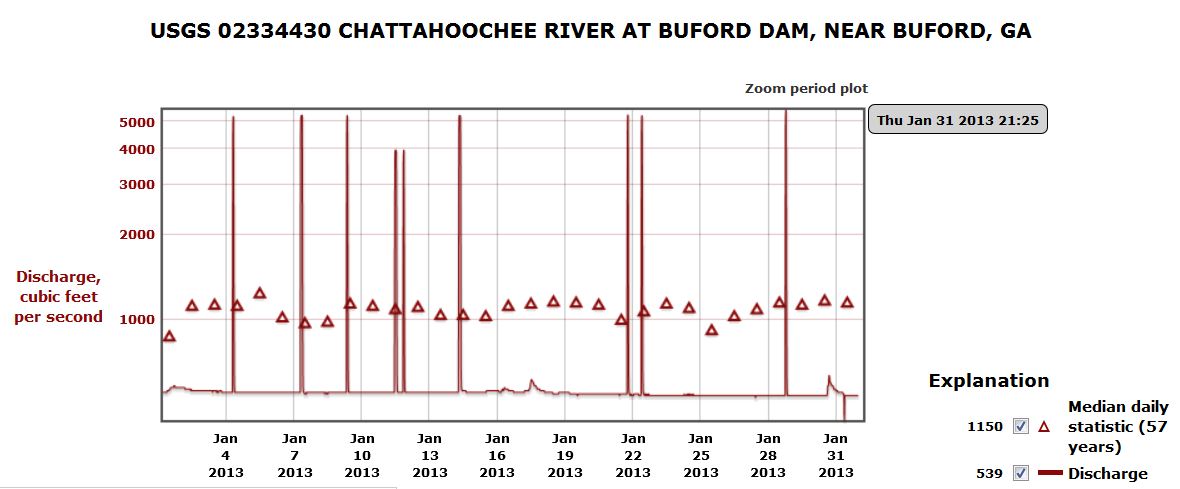
Records show that Chattahoochee River level directly downstream from Buford Dam have increased dramatically in just three days from 4.6' on July 24 2013 to 5.5' on July 25 2013 remaining same and constant on July 26 2013. The graph below courtesy of http://waterdata.usgs.gov shows that for July 2013 steady elevated rate of release has been maintained throughout the month.
 Discharges done in Jan. 2013.
       Discharges were fewer and much less in quantity!


NOTE: Both graphs show the 57 year median discharge rate which is about 1,000 Cu Ft/Second.
For the month of July 2013, releases are daily and amount is >10,000 Cu Ft/Second (~74,800 gps) causing the downstream river level to increase to record high levels.

That is an alarming rate of discharge!  Why haven't anyone down stream complained that river levels are flooding surrounding areas and local wildlife?  More about that later...
Suppose with current rainfall levels the Army Corps decreased release rate by a miniscule 10%.  Roughly the 57 year median discharge rate. What would happen?  Release rate would drop to 9,000 Cu.Ft/second (~67,320 gps).  Lake level could then increase by approximately 2.54" per month under current rainfall level and conservation restrictions.   At that rate of discharge, Lake Lanier could attain the record high level set in April 1964 (1077 ft. Above Sea Level) in about 23.5 months.  Considering that the current rainfall levels remain constant or increase over the next 2-3 years and self imposed water use restrictions decrease consumption, the lake could attain that April 1964 level in under 18 months.
Why is this not happening?  Sturgeon and muscle Farming Industry has a hand in the turmoil.  Atlanta metro has its own major water waster that is sold to the public as entertainment.  Stone Mountain Park has attractions run by a private company.  That amusement company produces snow at the rate of ~60,000 gallons water from Lake Lanier per day to run an attraction called "Snow Mountain".  Boasting a 5 football field size hill of man-made snow the water waste is incredible running from Nov 25th - mid February every winter season.  All total about 5 million gallons of water  per season would be wasted to make snow.  All so people could pay >$40 to tube down a hill of snow in the middle of Georgia in February of 2013.  In the 2007-2008 Snow Mountain season, public outcry was so loud about the water waste that the attraction had its plug pulled.  Currently, there are heated legal battles going on for control of Florida water resources.   One current forefront battle being waged in Florida ( a recipient of Ga water resources) has a Canadian Company officially applying for a permit to suck 250,000 gallons per day of water for the use of a sturgeon farm which will produce caviar priced in excess of $3,500 USD per kG.  Another Florida legal battle is underway with a permit filed to suck 7.2 million gallons per day of water for another sturgeon farm.  This does not sound like activists fighting against the extinction of a rare fish that only survives on a farm for the sole purpose of producing a delicacy most people can't afford for the amount spread on a cracker, never the less who would want a kilo of that stuff.

There is something fishy at the lake and it is not the trout I am talking about.  It is the big money interests hiding behind a veil of "conservation" while producing high dollar snacks for the rich and famous.  I am afraid that Georgia, Florida, and Alabama Governments, Army Corps of Engineers, and big business are in a love triangle.  For the love of water is the love of money.  This has nothing to do with fish and game conservation or endangered species.  It is the river of money and we the people who depend on the lake for drinking water are up the creek without a paddle.

I implore those with the powers to do so to tell the sturgeon and muscle farm industries to take a hike.  They have nothing else in their concern but to drain all natural resource for financial gain while near disaster lurks in the delicate balance between rainfall, lake levels, consumption, and conservation.  To date, there are still restrictions in place with fines and penalties imposed for residents using water for non-sanctioned uses such as spraying kids with water in 90* heat and washing cars.  Yet, big business is filing permits to draw millions of gallons per day to cultivate a fish producing roe that sells for  $110 per oz.

Something is fishy and it stinks.

Scott R. Mayorga A.A.S., BS MT(ASCP)H CLS

Special thanks to the following website for resource material:
http://en.wikipedia.org/wiki/Lake_Lanier

Saturday, April 27, 2013

ShareThis Post!