Showing posts with label Life in the Lab. Show all posts

Saturday, November 9, 2013

Two College Kids Messing Around in a Morgue - Ruh Roh!

As young adults you, me, we all did dumb stuff from time to time...
 

Like the time a friend and I went down steep-steep Cotton Tail Road on our skateboards with no helmets or safety gear and crashed hard resulting in many inches of road rash and near concussions.  My head bleeding, my forearms looking like chop-meat, I then proceeded to drive us both home stopping at a convenience store for a soda.  The store owner nearly called the police on us.  Ah - those were the days.

You would think that working in a clinical laboratory, safety is a main concern and for the most part that is true.  But, when the manager tells two young lab assistants to dump some old chemicals down the sink, well mayhem can and will ensue.   This is the tale of what happens when critical thinking skills are not applied to a situation and great danger can overcome the festivities.

The word "old" is just a useless adjective when attached to the word "chemicals".  Chemicals in pure form should always be handled with a clear head and proper protective equipment.  Old chemicals can diminish in reactivity but still remain quite concentrated and active enough to cause bodily harm, damage, and other dangerous risks.

And so the story begins with a request from the lab manager of his young minions; "Take these boxes of old chemicals and dump them down the morgue sink - But be careful.  See photo below taken by Photographer Brandon Merkel of the laboratory morgue some 20+ years later.  We were working part time in a mental health facility laboratory with over 100 years of history.  Some of the chemicals were real old. But, you see we were educated, college trained, young, and rather invincible in our own minds.  So this was going to be an easy work day Right?
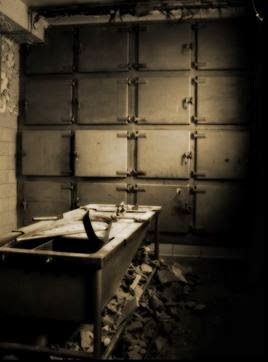
Photograph by Brandon Merkel

Well nothing was farther from reality.  I agreed to take the first few hours and my cohort would take over after I left for the day.  I proceeded to sort jars of chemicals by my own self starting relevance by recognition.  If I recognized the name of the chemical I opened the jar and poured it into the drain followed by copious amounts of water.  For the most part I was OK.  I had gloves, lab coat, and goggles covering my eyes.  Luckily, I was only working a 4 hour shift.  One chemical at a time followed by water, I was having good luck.  I was careful not to mix the chemicals together in the drain.  On and on it went.  No incident and no drama for me. Then it was time to leave for the day to attend my evening college classes.  My cohort took over.  He thought he was invincible too.  Unfortunately, he was not.  Critical thinking was not present in his work.  Instead of dumping - rinsing - waiting - repeat; his work flow was more streamlined.  He Opened several jars randomly grabbed out of the box, poured into the sink, after a scary amount of chemical was present water was added to rinse down the drain.  Well, under such a routine it was only a matter of time before disaster was at hand.  Several chemicals mixed together producing a cloud of dangerous noxious vapors which overcame my cohorts senses and eventually his faculties.  When he fell to the floor luckily he knocked down a box of chemicals and made enough of a ruckus that other laboratory staff heard and came to investigate what happened.  They pulled my cohort to outside air, opened doors and windows to release a eye tearing, breath stealing vapor cloud from the morgue.  My poor cohort almost bought it in the most ironic of places - right next to the morgue table.  What a disaster.  My cohort was alright though a temporary leave of absence was in order for the poor kid.  He was lucky that day.  So what have we learned?  Chemicals are dangerous.  Mishandling them is deadly.

As laboratorians working with various chemicals on a daily basis we are trained how to properly handle chemicals, how to mix them, and how to dispose of them whether in pure or aged state or post use.  This is all very good to know. But what about at home? Should we be concerned about household chemicals present in our living spaces?  The answer is an emphatic YES.

Here is a brief list of do's and don'ts for chemicals around the house.

Keep chemicals in original containers.
Date opened chemicals so you can keep track of their age, use, and reactivity.
Do not mix chemicals together.
Follow "How To Use" instructions directly on the label without deviation.
Discard empty containers.  Do not use empties for storing or preparing other chemicals.
Acquire MSDS forms for the cleaning chemicals you have in your home from the manufacturer; for example SC Johnson. 
If you purchase concentrated cleaners and mix with water also purchase generic non-labeled application containers or sprayer bottles for such use.  Mark the container with exactly what is contained and at what concentration.  Date the container with the date of preparation.  In the event of an accident with the chemicals, a spill, or splash in the eyes it is important to know what exactly the chemical compound is.
In the event that a child has exposure to the chemicals, it is critical to know and be able to calmly tell
poison control what chemical and at what concentration the exposure happened with.

Don't;
Mix different chemicals together - Cleaning a toilet bowl then spraying the seat with a chlorine based cleaner can result in deadly vapor production.  In the enclosed confines of a small bathroom you could wind up on the floor in trouble.  Some chemical compounds are heavy and thus hover the floor so your head on the floor is a bad place to be!
Don't;
Use old containers for preparing new cleaning solutions.  They are not properly labeled and the initial mix  of solutions may not work as expected or may be dangerous to handle.  An exposure at some later time may lead to erroneous information given to poison control in an emergency resulting in further harm or death to the affected individual.

Never: Mix chlorine based chemicals with ammonia based cleaners.  This is a recipe for quick
illness and death.
Never: Mix drain cleaners with anything other than water.  Use rubber gloves when handling drain cleaners, oven cleaners, or anything labeled as "Caustic".

The most dangerous chemical compounds you can purchase without special permits is by far caustic drain cleaners and concrete scrubbers (Acids). Absolutely, Do Not mix these together and it is against the law to use these products in a way deviated from intended use as per the product labels.


Don't be stupid my friends - use your critical thinking skills.  Chemistry is wonderful when used properly.
Please click through links below to important information concerning the safe handling of chemicals in the home...

OSHA.gov
American Assoc of Poison Control Centers
National Capitol Poison Center
US Chem Safety Board
Guide to Chemical Hazards

Brandon Merkel is a photographer on Long Island NY.  Permission was granted by Mr. Merkel to use the morgue picture above.  The picture was taken some 20+ years after this story took place in
Sept. 1981.  The morgue autopsy table is shown slightly out of original position and plumbing fixtures are missing in the photograph.  The 16 square doors oriented floor to ceiling are the morgue refrigerator.  I observed an autopsy in this morgue room.  This room was located in Building 23, Pilgrim Psychiatric Center, Brentwood, NY.  The predominance of the ground floor was clinical laboratory which I worked as lab assistant for 6 months until Jan. 1982. There are multiple pictures to be found on the internet taken in this morgue but show the condition of the refrigerator in various stages of disarray and destruction.

Scott R. Mayorga A.A.S., BS MT(ASCP)H CLS


Wednesday, November 6, 2013

Clinical Laboratory Licensing and Certification; What is the difference?

Laboratory Certification - Laboratory Licensing - What does it all mean?

 With over 239,000 clinical laboratory facilities registered in the US under CLIA - Clinical Laboratory Improvement Amendments; the public can get quite confused about regulations, certification, and licensing of these facilities.  Under CLIA, there are 29 different categories of Clinical Laboratories.  These can range from a mobile facility on wheels, health fares, hospital labs, and the mega reference labs performing millions of tests per year.  Various States operate licensing or permit programs of clinical labs.  The employees working the lab bench performing the testing of specimens are regulated by certification agencies and State level licensing via each locale.  So what is Laboratory certification?  What is the difference between certification and licensing?  Can a laboratory be certified but not licensed?  Can labs be licensed but not certified?  Can labs lose either certification or licensing and continue to operate?  I will try to answer these questions and explain concepts which can be confusing to laboratory consumers.  What is a Laboratory Consumer?  A lab consumer is you, me, the patient in general.  The doctor orders blood testing for us.  We go to a laboratory to submit specimens for testing, or the Doctor collects  specimens in the office and labs pick them up, or hospital staff come to your bed side to collect specimens.  Your specimens are received in a lab facility and tested.  Laboratory results are then delivered to the doctor who ordered your tests.  We are all consumers of lab testing facilities.  You do have a choice of who, what, where your specimens go for analysis.  What about that lab data?  What is a lab result?  What is lab data?  Laboratory data is the data produced within the laboratory from analysis of specimens; Unconfirmed data.  Clinical Laboratory Scientists test specimens by various methods and instrumentation.  Until that data is confirmed it is just that - data.  Once the data is verified as accurate and under control then the data is confirmed as laboratory results.  Lab results are then conveyed to the doctor for his or her evaluation.  This is a crucial concept to understand.  Lab data is subject to all sorts of regulations, guidelines, control, and evaluation before the data is declared laboratory results.  Just because a lab instrument issues numerical data does not mean that data is ready to be used to evaluate your medical condition or asses the health of an individual.  If quality control checks fail during the analysis of my specimen then the analysis is flawed and must be repeated and evaluated.  If my specimen does not meet guidelines for analysis then a new specimen must be obtained for testing.  Lab results are reported to our doctors.  Lab data is the unverified numbers or raw data issued by the testing method.  You nor I want lab data reported to the doctor.  We want verified lab results being perused by the doctor.

Laboratory licensing is sometimes synonymous with the Lab Permit.  Laboratories are a business.  Labs pay taxes to cities, states, and the federal government.  Various fees, registration fees, rent for building space, etc.  are paid by clinical labs.  A lab must have a permit to operate and test specimens.  Depending on the location of the lab facility a state permit is required and issued by the state department of health to the laboratory on an annual, bi-annual, or some other time period basis.  Renewal is required.  Some states also require inspection of the laboratory facility to maintain license or a lab operator permit.  To complicate the licensing issue, some specimens are collected from patients and transported across state lines or across the country to a central testing facility.  In those cases, the state where the specimens originate have jurisdiction over the performing laboratory no matter where the lab is located.  I personally know of a clinical laboratory that holds national certification but lost a state license due to revocation.  Even though this is a laboratory with quality processes, this facility is analyzing specimens without proper license from a state where samples are collected and jurisdiction is owned.  These lab results reported to physicians are reliable however there is great liability and risk if this facility where to be embroiled in a litigious process.  Basically, in absence of proper licensing laboratories are a risk to public health - especially when there is revocation involved.

Certification is the process a clinical laboratory under takes to gain prestige amongst other clinical laboratories and other competing laboratories; competing for our business.  Is certification of a clinical laboratory required?  No.  However, certification can be a supporting factor in the permit or licensing procedure of a laboratory.  Just depends on the licensing body of that facility.  Various organizations can certify clinical laboratories; the most notable is CAP - College of American Pathologists.   CAP certification is optional is some states or locales; however, that is a tricky road to embark on if you are a lab owner.  CAP certification is often inter-twined in the licensing procedure.  Just depends where the lab is physically located.  Hospitals can also be monitored/certified by JCAHO - Joint Commission on Accreditation of Health care Organizations.

CLIA Certification is different than lab certification described above.  CLIA certification is the permit or license if you will issued by the federal government so that a clinical laboratory can receive payment from CMS - Centers for Medicare and Medicaid Services.  A lab must be CLIA Certified to receive payments for testing specimens of patients enrolled in medicare or medicaid.

So, now that we know about laboratory certification and licensing what now?  Is this important?  Should a patient be concerned about these concepts when they visit their doctor for a check up?  The answers are yes, yes.  There are labs out there that either are not certified, not licensed, or have lost license or certification, or otherwise there is a lapse of one, both , or the other.  If there is a loss of either license or certification the big question is why?  Did the loss occur because of quality issues, performance issues, or some sort of regulatory infraction?  Either way, would you want your specimens used to screen your health analyzed by a laboratory that has lost certification or license?  I think not.  Do you feel comfortable bringing your car to Joe Smoe shade tree mechanic or your next door neighbor to fix your transmission?  No you don't and you would not do that.  You want someone who knows what they are doing and can prove it. The same with a clinical laboratory.  You want your specimens analyzed at a fully licensed, boastfully certified laboratory that can prove it 24/7/365.

But does a patient really have a choice where their specimens wind up to be tested?  Well sort of.  That depends on their doctor.  Some doctors have business relationships with clinical laboratories.  There is much federal regulation about this area of health care involving the prevention of kick-backs by labs to referring doctors.  The relationship is a loose agreement that the lab will pick up specimens and deliver medical reports to the doctor and may also provide supplies to collect specimens.  Anything more than that basic arrangement between doctor and laboratory and someone is going to jail.  There has been recent re-occurrence of kick-back payments by labs to doctors whereby thousands of dollars are passed to the doctor each year for the lab business from the doctor.  Prosecution of these cases has resulted in doctors going to jail for a long time.


However, you do have a choice where your specimens go.  When the doctor orders testing the order can be written on paper, or script.  You can take that script and go to any lab of your choosing.  You can do your own research and verify the certification and or licensing of labs and go to the one you are satisfied with.  Otherwise, you can let your doctor choose where the specimens go.

Be wise about your health care and be an informed consumer of health services.  Not all labs hold the proper license and certification to perform testing of your laboratory specimens.

To find a CAP Accredited Laboratory near you anywhere in the world click this link:
CAP
To find Laboratories that hold License with New York State DOH click this link:
NY State Clinical Laboratory Permit Holders
To find a licensed laboratory in Florida click this link;
Florida Laboratories
For more info about Laboratory Certification and certification of Clinical Laboratory Scientists
click this link; ASCP


Scott R. Mayorga
A.A.S., BS MT(ASCP)H CLS
Straight Talk From The Hematech

Sunday, September 22, 2013

The Whacky Antics of a Laboratory Night Shift Staff; No Not My Lab? - Oh Yes!

 What goes on behind the door down the hall leading to "that Laboratory"

For the most part Clinical Laboratories are tight run ships, designed with aspects of quality, efficiency, and redundancy.  Staff are well trained and train new staff as needed.  Equipment is well kept, maintained meticulously, calibrated per specification, and checked with quality control systems on a daily basis.  The busiest sections of a clinical laboratory often have multiples of the same instruments to have built in redundancy in case an instrument needs maintenance or is flat out broke.  The work goes on especially in a hospital laboratory where it is 24/7/365.  Well what about those clinical laboratory scientists?  Are they calibrated, checked with QC, well maintained, with built in redundancy?  You can bet on that.  Often, the off shift staff are highly trained multi-taskers who master all sorts of tasks on all the laboratory instruments and procedures.  When one scientist goes on break another can come up right in their place and carry on the task at hand whether it be calibration procedures, quality control processes, specimen testing, or maintenance.  What about that break time?  What about when sample receipt in the lab is slow?  What do the wacky scientists do?  I will tell you what they do?  They play Bocce-Bagel! They play Poker.  They sleep.  Sometimes they sleep at the microscope-more about that later.  They take the elevator up to the roof of the building.  Most laboratory directors would say "not my staff - not my night shift, they don't do those sort of things". 

Let me tell you as one who worked many years on the off-shift in a terribly busy Level 1 trauma center; there must be some entertaining distractions or quality of the work will suffer, boredom and weariness set in.  Mostly the distractions clinical staff will employ to refresh themselves are harmless and rarely illegal.  One such distraction for our group of night shifters was what we called "Bocce-Bagel".  Day shift would often get goodies from vendors and often those goodies would consist of several large bags of bagels.  Bagels are cheap. They were plentiful.  It would tick us night shifters off when a dozen or more bagels would be left out open on a counter all day and were stale as a brick by 11 PM.  Oh yeah there would be a note on them "Enjoy", but enjoying them meant cracking your teeth down to bloody nubs! So, what do a dozen half baked scientists do with 2 dozen stale rock hard bagels?  You guessed it.  They throw them around and eventually come up with a systematic way to diffuse on the job stress - the Bocce Bagel way.  This is how you play.
Get your bagels and hand one to each player.  If they are all plain bagels name them with a lab pen.
Go down the hall; every lab has a long hallway of say 25-30 feet long ending at a wall.
Ante up with a quarter, dime, or for the money bags amongst you all, play for a dollar a toss.
One by one players toss their bagel down the hall towards the wall.
Player who comes closest to the wall wins the toss.
Repeat as necessary to relieve stress.

So what are some of the antics we resorted to, err I mean employed to diffuse stress, refresh, and otherwise widen our eyes?  Well of course Nap.  Cat nap that is.  Some of us learned to nap in a lab chair devoid of arm rests; that is quite a feat let me tell you.  Some labs have phlebotomy chairs.  Cushy, comfy chairs with arm rests just like Grandpa used to lay in on a Sunday afternoon and "Cat-Nap".  Oh yeah!  I worked in a hospital a short time that had a cot.  A real good cot padded heavily with accompanying blankets.  Uh well I am just saying it was a nice cot in case a patient was feeling ill during phlebotomy procedures.  Other means for a quick cat nap often make you look like your are actually doing work! Imagine that.  You walk into the lab and see Charlie over their working his heart out at the microscope.  He's reading gram stains and cell counts on that spinal fluid that came down from the ER.  NOT!  Charlie is sleeping.  He looks like he is working.  His forehead is resting on the microscope oculars and he is lights out.  10 minutes, 15, 30 minutes go by...maybe someone should go wake up Charlie; he has been reading that same gram stain for the last half hour.  Nah - let him sleep.  An hour goes by.  A code is called over the public address system.  Charlie wakes up and oh yes he has the tell tale signs of "Ocular Narcosis".  Hard circles embedded so deep into the skin of his forehead they barely go away by the time the day shift starts showing up.  "Sleep is a beautiful thing", I think some mattress company once said.  Anyway.  What else did we do.
Lab Scientist Ocular Narcosis

Exploring - Yes we were like Magellan and Christopher Columbus going where we never went before.  Up the elevator, down to the basement, out the back door, we would have gone to the moon and back if we had a space ship!  One such jaunt was scary as hell.  It was winter, dead winter and January cold.  Windy, blustery, and freezing.  Let's go to the roof! Yes lets get on top of the building and look out over the land.  With only our lab coats to protect us up the elevator we went to the 19th floor.  We searched for a way out and the way out we wanted was in the vertical direction.  Yes we found it.  It looked like a broom closet door.  After we pried it open, alas there was a cat walk and narrow metal grate stairway going up.  After climbing up the the narrow stairs another door but it was unlocked this time.  We did not mean to fling the door open but it sort of pulled out of our hands.  You see the wind created a draft so strong the door flung open viciously as soon as it cleared the latch mechanism.  Oh wow.  Look at that.  You could see for a great distance up here.  It was dark, it was very windy, it was shiverrrrring cold, our teeth were chattering.  There were no safety bars, no fence, nor any other safety mechanism from keeping us on that roof and not flying away like the "Flying Nun".  Ok lets go back down now - yeah lets its cold up here!

Another pass time came from necessity.  You see at the back hallway of the laboratory was an exit door leading to the outside out to the back of the hospital.  Just outside the exit door there was the new MRI building.  MRI was new back then.  MRI was a mysterious machine housed in a closed off building.  No Metal Objects Allowed the signs all said.  Well we kept away alright.  But there were others that were brave enough to get close to that building.  Flies.  Insects of the black Fly kind.  I swear I never saw flies so big almost the size of a quarter.  They would come into the building from the back door out by the new MRI building.  Those incredibly strong magnets were growing flies so big they could take down a small dog.  Into the lab they would fly those flies.  They were hungry flies.  You know what they liked to eat?  Blood smears.  They would land on the freshly made blood smears in Hematology lab and suck up the drying blood on the glass slides.  How disgusting is that.  After their meal they would fly up to the ceiling and warm themselves around the fluorescent lights.  I had to do something about this.  That back door was used as an employee exit so it was constantly letting flies into the building.  We had patients up stairs for goodness sakes.  So here comes Hemabond to the rescue.  Hemabond was the ultimate laboratory multi-tasker.  Hemabond carried a gun - a very nasty rubber band gun.  Loaded with discarded rubber tubing from the coagulation analyzer and adeptly handled by the likes of Hemabond those flies did not have a chance.  I kept the gun inside my lab coat.  Down my sleeve it would sit at the ready.  It was big enough to stretch the rubber tubing 10 inches!  It had a real trigger mechanism.  It was a real beauty of hard wood and metal parts from a hanger used to hang slacks in my closet.  Doctors would walk into the lab and not have a clue they were talking to a super-hero of sorts, carrying a high powered rubber band gun.  Legend has it that I was on the phone calling a critical lab result, sitting in a lab chair at the front of the lab.  Another scientist walked in and pointed up at the ceiling.  I pulled out my weapon of mass fly destruction, aimed with one arm while giving report to a nurse, BLAM! Down that fly came.  Charlie was impressed! He laughed all the way back to Chemistry lab.  I even went out front of the hospital to the traffic circle, sat on the benches, concealed carrying my weapon under my lab coat.  Oh what fun!

Then there was the cafeteria.  Oh the joy of the cafeteria at 2 in the morning.  The grand eatery would open to a narcolepsy afflicted crowd.  One notorious morning, we ventured up to the cafeteria cause this was a typical laboratory down in the basement, two floors below ground, except for the exit out back by the MRI building.  We were bored almost to death.  The usual cafeteria fare was abundant like burgers, eggs any style, toast, day old wrapped sandwiches and other nutritionally challenged offerings.  Peering down into the wells in front of the "Chef"; well she had chef clothes and a chef hat  so we assumed she was a chef.  Who were we to challenge her - who cared?  One of us was bold enough to ask what the green stuff was in the smoldering stainless steel bin with green crud caked up on the sides an inch thick.  As it turns out that was "Split Pea Soup".  Your head had to be split open with a hatchet before eating that stuff.  "What you got to go with that brown gravy" was asked of the esteemed chef?  She looked at the offerings in front of her and said "nothing?".  She had gravy, brown gravy.  No mashed, no french fries, no biscuits, no roast beef.  Nothing to go with the gravy!  Such was the grand experience of the cafeteria at the big hospital at 2 AM.

What else did we do.  Let me see...  Oh yes, Cards.  We played poker in the big conference room.  We had seating for 20 or so.  Sometimes it got cut throat. I did not play much.  I hated to part with my money that way back then.  So I just watched and was glad I was not involved in the sham of it all.  I guess sitting there at the table watching was almost as bad as participating directly as far as management was concerned.  I did like Boccie-Bagel though.  And I always had the Hemabond gun in case things got out of hand.

Well you see working night shift is tough.  You constantly feel like you are sleep walking, everything is "fuzzy", your eyes are tired and blood shot, always weary.  Distractions were just a way to cope with the stresses of the job.  Coffee, lots of coffee helped.  We really did not need the cafeteria though because when we got together for holiday celebrations we really had a feast.  We had a whole turkey dinner once.  All the fixings and deserts abound.  We really lived it up on the night shift.  The work got done.  We did our jobs. We were saving lives.  Level 1 trauma lives.

Well take care my Lab friends.  Don't wake up with Ocular Narcosis.  Your reading glasses will not cover those deep circles.

Scott R. Mayorga  A.A.S., BS MT(ASCP)H CLS


Wednesday, September 11, 2013

Excuse me - How cold is the Dry Ice in that Cooler?

 Dry ice maintains a temperature of -80ºC which makes it a perfect shipping medium for blood products, frozen foods, and other temperature labile items

If you are a manager, supervisor, head, chief or otherwise known as leader in your organization you know full well being placed in the "Hot-Seat" becomes a comfortable position par for the course that comes with said titles.  Eventually, being looked upon as the leader can have its trying moments.  I have explained in previous posts about representation of a laboratory facility in an inspection or audit role.  In a less stressful situation such as interaction amongst staff of your own facility things can still get dicey.  Decorum, tact, and Witt will always prevail in every situation or interaction.  As the leader you are relied upon to give sound judgement, smart opinion, astute evaluation, and complete answers to questions.  As the leader, sometimes it is hard not to get "Fed-Up" with ridiculous questions or challenges that sometimes challenge not only reasoning skills but also patience.  Working in a large facility with hundreds to thousands of fellow staff members it is only a matter of time before one of those staff members really tries your patience.  Here is one such observation that although I gave a good observation and astute answer to a ridiculous question I ran the risk of running myself under hot water.  Every situation is different.  Whenever patient care is involved you always have to give 100% attention and serious response.  When the same issue is bantered about over and over again sometimes it is best to stop the BS and say it straight - Straight Talk From The Hematech.

Dry ice is nothing more than solidified carbon dioxide with some impurities mixed in.  As such, this substance is very efficient at keeping materials in close proximity in a frozen state.  Dry ice maintains a constant temperature of -80ºC which is very, very cold.  Laboratorians know that in order to keep blood specimens stable for long periods of time -80ºC is the temp required inside a frost-less freezer or dedicated laboratory grade freezer.  If specimens are going to be shipped across the state, overnight, or across the globe the only way to do that is with a well insulated cooler box full of dry ice to keep the specimens in a frozen stable state.  Well everything works great when there is enough dry ice packed in the box, the box is sealed properly, and the shipping is prompt and on time.  A small cooler box with 1-2 lbs of dry ice sealed appropriately will keep contents frozen for up to 5 days.  Add more dry ice such as 2+ lbs and you can insure stability of contained specimens for up to 7 days.  

This is the story of a physician office that would just not follow directions for shipping frozen specimens.  If you put a couple of pebbles of dry ice in a box you can't expect to have stability for very long.  That will not last more than an hour or two.  Well, delivery after delivery, specimens from this one physician office arrived devoid of dry ice and warm as the ambient temperature.  After several failed attempts to ship specimens to the core lab something was just plain wrong and the responsible people for packing and shipping were failing in their duties.  Project management type staff members are responsible for well managing the project and the customer.  I had had it by now.  After many emails back and forth, phone calls, disputed state of arriving cooler boxes it was time to educate the project manager.  One such day, a cooler box was expected from said physician office with supposed frozen specimens.  I notified the project manager to come to the lab to visually inspect the cooler box as it was opened.  The project manager ran right over.  As several of us, me the lab manager, several technical staff members, the project manager who was in a new position, and an assistant we all observed the opening of the box.  What would we find?  A box full of dry ice and specimens or another failed attempt at shipping specimens.  Well, after anticipation of the physician staff finally getting it right - No, just a box of warm specimens and no sign of dry ice.  What could possibly be wrong?  Why is this happening?  "Something is terribly wrong" said the project manager.  I said, "yes something is wrong - if they placed the required amount of dry ice in the box we would have frozen specimens today?"  Some banter went back and forth with the project manager; yes they were putting in dry ice, yes it was the right amount, then the ridiculous started.  Assertions flew about the cooler box and how faulty it was.  That was hog wash; it is a styrofoam box used for hundreds of shipments each day to that facility.  Then the "Piece de resistance" came out of the mouth of the intrepid project manager.  She asked, "So- how cold is the dry ice is those boxes over there?"  I replied, "they are full of dry ice and dry ice is -80ºC."  Then she asked, "Well how do you know that dry ice is cold?"  I looked at her dumb founded.  Devoid of an astute smart complete response I said the following; "Well,... stick your hand in a box of dry ice for 30 minutes, take your hand out, then smash your hand on that table over there."  "If your had shatters into a million pieces you know that dry ice is cold."  Of course that elicited a dumb chuckle from the assistant and some smiles from my staff in attendance. Blank stare from the project manager was followed by more dumb inquisitive banter.  Now the morale of the story is I might have felt better after I said what I said and it really needed to be said at that point in the situation - but that banter would come back to bite the lab.  As it turns out that project manager started dating the medical director of the laboratory.  Over head pages from the project manager emanating from the sound system through out the facility complex were heard beckoning the medical director by his pet name which we all promptly heard for the first time and only time.  I guess she got the smack-down because she never over-head paged the man again.  Anyway, might I digress?  She suggested to the medical director probably over sultry pillow talk that the cooler boxes used for transporting frozen specimens were faulty.  It could not be the staff of the physician office not placing enough dry ice in the boxes; No it had to be the cooler boxes.  Well that prompted a very scientific, thorough, and painstaking review of so said boxes.  The result of that validation found that not only were the boxes doing their job the specimens were perfectly safe for a very long travel.  

Here is the validation overview:
A handful of specimens were packed in a standard styrofoam cooler box ( approx 8" x 8" by 12") with 2.2 lbs of dry ice. In with the specimens was a very expensive temperature recording device that was capable of recording the environment temperature for over a weeks time.  The box was packed and shipped exactly as instructions were given to all physician offices shipping samples to the core lab.  The package was shipped over 1200 miles to an office then without opening the box it was return shipped back to the lab.  Well, low and behold, the temperature inside the box never wavered, dry ice was still in the box upon its return to the core lab, and specimens maintained frozen state the whole way.

Yes, dry ice is cold, very cold.  It makes for an efficient medium to pack and keep frozen all sorts of items such as foods, chemicals, and blood.  The validation was a success.  Eventually, the physician office caught on and thawed specimens were seen no more.  Good for patient care - good for my sanity.

So, think about that wise crack before you let it fly.  You never know if the receiving person is going to sleep with your boss and cause you grief.

Take care my laboratory friends.  Be careful what you overhead page.  
Another tip! Be careful of the email you send.  How embarrassing it is to be in a room observing a presentation from a managers laptop, projected on the wall for all to see.  Then in the lower right hand corner MS-Outlook flashes the subject line of an incoming email and the senders name.  Whoops, there flies another pet name!  From another Medical Director to the underling.  How true, how sad, how true.

Scott R. Mayorga A.A.S., BS MT(ASCP)H CLS

Monday, September 9, 2013

How to Pass the NGSP A1c Proficiency Testing Survey Like a Pro

 Proficiency Testing (PT) of clinical laboratories is an important part of Laboratory Quality Assurance

All clinical laboratories participate in subscription type PT such as (CAP) or CDC Lipid Survey in addition to State Sponsored PT programs such as N.Y. State DOH or PA DOH, etc.  One of the toughest most difficult PT surveys to pass in my opinion is either the CDC Lipid Survey or the
NGSP - National Glycohemoglobin Standardization Program.
HBA1c is a component of Hemoglobin that is glycated (Hemoglobin + Glucose) at normal levels in patients with normal sugar metabolism.  Individuals with diabetes do not metabolize sugars normally and therefore glucose levels in the blood are erratic leading to all sorts of ancillary disease states of the kidneys and circulatory system as well as negatively affecting ones vision and propensity to develop infections.  Good glucose control is the key to surviving with diabetes for an extended lifetime.  Those with poor control of glucose suffer many different ways on a daily basis and do not live a long life time.  As a clinical laboratory it is for the good of all people to be able to produce the most accurate reproducible data possible day after day, patient after patient, normal and abnormal.  Passing a HBA1c CAP survey is good but passing NGSP is better.  Then there are some patients that have a Hemoglobin make up that interferes with all HBA1c testing methods. For more info on that click here;Testing interference with HBA1c

NGSP is a subscription PT testing program that challenges all aspects of a laboratories glycohemoglobin testing including the testing platform, reagents, calibrators, user technique, and ancillary equipment.  NGSP is the ultimate PT QA program for ensuring quality in testing and reproducible results in HBA1c testing.  Click here for more info about obtaining certification. The data analysis of the NGSP PT results are so exact and statistically critical; passing this survey a difficult endeavor to undertake.  I know, I have managed a laboratory that successfully passed the NGSP for 5 years straight while employed at that lab.  Possibly not as excruciating to pass as the CDC Lipid Survey which I also participated in and actually visited the laboratory at the CDC in Atlanta that prepares the specimens for the CDC Lipid Survey.  I sat down to talk with the director in charge of administering the CDC Lipid Survey program; that was really neat.  The next CDC Lipid PT I had overseen passed as well.  Although, continued success with the CDC Lipid PT is almost impossible under the scrutiny of any manager.

Let me tell you about my experience with the NGSP PT Survey and offer some helpful hints to any laboratory wishing to endeavor down the path of NGSP Certification.  NGSP is a certification process whereby a laboratory, instrument vendor, or other entity is awarded certification for one year.  Renewal of the certification occurs on an annual basis on the certified labs anniversary.  There are 4 testing events throughout the year including the certification or re-certification process and 3 quarterly testing events.  Each testing event consists of small samples shipped from NGSP HQ on dry ice to the subscribing laboratory.  Each testing event must be completed within stipulated time period with results emailed, shipped, or otherwise electronically returned to the NGSP program for analysis.
NGSP will statistically analyze submitted laboratories data and compare against other certified laboratories.  The comparison performed may be against same method or different methodology.  It really doesn't matter who is used as comparison.  NGSP is the standard by which all instruments, methods, and laboratories are compared to.  Your lab either compares or does not.  If your lab compares well enough on the certification PT process Level II certification can be obtained.  If your lab performs really well, Level I Certification is obtained.  Currently for 2013, there are 138 laboratories worldwide that are certified with 100 certified as Level I labs.  There is a reason why some lab can only achieve Level II certification - The process is arduous, difficult, stressful, and fraught with possible minute unknown errors in testing that can skew results tenths of a percentage which can make any lab a Level II lab.  It is rather stressful simply because the annual expense  is $5000 USD for a Level I lab and once you achieve Level I and the status the certification brings to a lab it is terrible to lose that status.  NGSP and the directorship of that program are globally recognized as experts in HBA1c metabolism, testing, testing methods, and testing procedures not to mention a fine PT program with astute statistical data analysis.  If your lab is contemplating NGSP Certification then buckle up ~ you are in for a rough ride.  Put up your money and get prepared to take a beating.

Ok lets get started - What do you need to know?
1st - NGSP is not your run of the mill CAP survey.  There are more samples to test than CAP and lets face it passing a CAP survey for HBA1c is like driving a car through the Lincoln Tunnel.
 CAP HBA1c 2013 Summary  The data analysis applied to the NGSP  survey program is exacting and tight.  There is no room for error and minute changes in instrument function form day to day will bring you down to Level II fast.
2nd - Do your homework.  Go to NGSP on the World Wide Web and look around.  See who is listed as Level I and Level II.  Make sure you take note of the manufacturers and what they routinely pass as either Level I or Level II.  If a particular instrument can't routinely make Level I what makes you think you can do better with the same instrument on your lab bench with your scientists? If you don't have a Gold Standard method think about getting a Gold Standard method Such as Tosoh or Bio-Rad before going down this lonely country road to NGSP Certification.
3rd - Make sure you have well trained scientists who can tell the instrument is not running right on a minutes notice and can rectify issues expertly.  Also, make sure your maintenance program is fastidious and complete without lapse.  Make sure your chemistry is spot on.  Everything about your instrument has to be perfect or even Level II will be out of your grasp.
4th- If you currently have QC ranges that you can drive a city bus through (> 0.3% HBA1c on any given level of Quality Control) and use every tenth of that range on a monthly basis you are going to fail miserably.  Don't even think about NGSP if you can't handle an sd of 0.1 across your whole testing linearity.  Your lab will fail miserably otherwise.
5th - Once Level I Certification is obtained a Level II testing event will place your lab on "Probation".  Passing the next quarterly event with Level I is a necessity otherwise your Lab will be officially graded as Level II for your poor Level II two testing event performance.  

So- you have the nerve to force your scientists to a 0.1 sd under much grumbling from them and you are confident for several months like that.  Go ahead - go for it.  Just know that one little slip of the wrist during pipetting, diluting off by tenths of a %, and any maintenance lapses will cause unknown suffrage and possible failure.  Even Level I labs suffer an inconsistent Level II testing event now and then; in five years of straight NGSP testing I had two Level II events; that was 90% Level I for 5 years.  If you consistently use the same instrument, the same scientist, the same pipettes, chances are your consistency will prevail a strong Level I performance time after time.  But, that is not reality.  If you have the stomach like I do you will monitor everything like a crazy nut ensuring that no matter what instrument, what scientist, what pipette, what Lot number of reagent, and what calibrators are used, and dam those torpedo's. I passed year after year after year.  Yeah - that's how you do it.  I had 6 instruments and 7 scientists and rotated amongst them all with expert success.  Am I bragging - You Bet! "Don't try this at home folks I am a professional".

 Alright you take the plunge - You purchase your certification kit and wait for it to arrive.  Now what?
Make sure you have staff on hand that can competently receive and store the testing kit once it arrives at your facility.  You must keep the kit frozen at -80ºC at all times until ready to test.  -20ºC is going to ruin the samples.  If the kit gets lost in your facility and the samples thaw uncontrollably you are going to have to beg NGSP for another kit.  Do it a second time and you may not get a replacement kit.  If the kit gets lost along the way you must let NGSP know immediately after the expected receive date.  That is not the labs fault.  But, once the package is signed for it is yours.

Make sure everyone involved in the testing is trained well, knows what they are doing, can handle the 0.1 sd QC no problem, and did I say they must know what they are doing???  I am not kidding.  There is no room for minute error in the NGSP statistical analysis.

Make sure your instrument maintenance is up to date or complete it before the testing event starts.  Be careful though.  You must also ensure mechanical performance will continue for the testing event.  The last thing you need is for mechanical failure in auto dilution area of the instrument day 3 or 4 into the testing event.  If this is your Certification Process - you better pray nothing happens during the 20 days of testing!  You bet. That is what I said.  Certification is 20 straight days of testing HELL!  If anything breaks down during that time, you better fix it and fix it so the instrument performs just the same as before it broke.  Hence you will fail miserably.

A word about calibration.  Most HBA1c instruments produce a calibration from two analyzed samples in the calibration kit and that kit is compatible with certain or single lots of reagent.  Make sure you are following instrument manufacturer guidelines for use of calibrators exactly as specified.  No cutting corners, no deviations, no mistakes or you will fail NGSP miserably.
You must make sure everything about the testing instrument is perfect, producing the same result on the same sample day after day after day.  NGSP is not only testing for accuracy but just as importantly reproducibility.  Don't kid yourself and don't be a fool. Preparation is the key.  Human error is the enemy, instrument mal-function on a sporadic basis is the unknown.  You will know something bad happened that you were not aware of when you get your results back from NGSP and you missed Level I by 0.03 or something minute like that or worse yet don't even make Level II performance.

Ok, so I think I have successfully scared anyone unknowing of the the NGSP process.  Can it really be that bad?  Yes it can.  Can Level I labs fail now and then? Yes.  Will they ever figure out what happened? Possibly not.  Will they pass next event with Level I performance?  probably yes.  But just remember, out of 139 certified labs only 100 attained Level I Certification.  39 labs were unable to attain Level I performance for two straight testing events!  Here is what you really need to know to successfully pass this arduous PT program.  
  • Xanax will be your friend.
  • Treat your NGSP testing kit samples like gold.  Refreeze them immediately after done testing the samples for the day.  Don't waste them.  Don't wait hours to refreeze either.  Unstable NGSP samples are a terrible thing to use.  Make sure they are clearly identified for future use.  NGSP knows labs save the samples for future reference and they send only about 0.5 mL of sample in each tiny vial. Re-test old NGSP samples before the testing event starts.  This will insure exact analysis is coming from your instrument.  If you have more than one instrument then test against both or two or three of your available instruments.  Pick the best performing instrument.
  • Once you establish that your instrument is analyzing exactly as needed Do Not Make Any Changes that will affect performance.  Get your maintenance procedures done an any instrument that may be used for NGSP, preliminary test with old NGSP samples and calibrators as unknowns, then promptly start NGSP if you are satisfied.  The more time that elapses after you "prelim" the instrument and NGSP testing starts the more unknown can happen.
  • If your staff is not comfortable using such small quantity of PT sample in a small tiny vial then have them practice with such small vials before the testing event begins.
  • Save calibrators that were used during very successful NGSP testing events.  Test these calibrators as unknowns in the same manner as true NGSP samples will be tested in your lab.  Make sure you are recovering exactly the data you expect with the saved calibrators.  This can be used as a reference mark to make sure analytically your instrument is performing optimally before the NGSP testing event commences. 
  • Make sure any pipettors used are in good mechanical order and are calibrated as exact.  This is going to be the most common issue that will bring you down to Level II or fail you miserably.  I cannot stress this enough.
  •  Make sure you have enough reagent on-board to complete the testing event.  If you run out of reagent mid way and change even a buffer solution, you run the risk of failure.
  • Make sure your scientist is a pipetting expert.  Pipette by the book.  There is no room for slouching here.  Practice can be obtained via a laboratory scale.  The testing scientist must be able to pipette minute sample amounts with the same accuracy time after time.  Practice until perfect.  Did I already say that pipetting errors will bring you down?  Take heed.  Make sure the technique is spot on perfect.
  • Make sure you know what type of freezer is used to store the NGSP test kit.  If you store in a frost less freezer you will ruin the samples.  It is a done deal.  Get yourself a good lab grade freezer that will not cycle off and on furiously to avoid frosting.  Yes they are expensive and frost will build up inside like a glacier but that is the only way to successfully store the kit and any samples you save from the kit post test event for future reference.
Overall you must be confident in your technology, your technique, and your abilities.  If you have all three you will pass.  If you falter, well you know the end result.  Level II or worse and ultimate humiliation of not passing a PT you paid good hard earned money for the nerve to take a numb skull crack at it try.  

If NGSP is for you - know well what you are getting into.  Only a short list of labs can pass this strict PT program. Will you be one of them?  Do you have the nerves of steal?  Do you have the knowledge and experience with your testing method to realize what is good and what is bad data and how to fix that mess?  If so, see you in the winners circle! http://www.ngsp.org/docs/labs.pdf

 Take care my brave friends - Test with confidence and see you in the NGSP winners circle.

Scott R. Mayorga A.A.S., BS MT(ASCP)H CLS


Thursday, August 22, 2013

She's wearing a see through blouse - Are you kidding me?


Playing the role of a manager in any industry requires quick reflexes, change on the fly decision making, and having "wherewithall" to quickly assess a situation and intervene appropriately.  Reacting to a bad situation unprofessionally can set up a bad series of events leading to staff disciplinary action, your own disciplinary action, or decreased morale amongst general staff members.  Being able to assess quickly and react soundly is a chief attribute of a good manager.  Dealing with sensitive water cooler topics such as sexuality can be hazardous in the workplace.  Reacting poorly to such occurrences can land a manager into hot water fast.

One such issue came about which I will describe below and what is the proper way to handle such a situation.  Managing a huge staff of professionals is a daunting task.  Most of the time my major issues involved scientific questions and situations that effected the scientific work going on in a clinical laboratory.  When situations involve extreme emotion, despair, or horrific distress of an employee care must be taken to handle the employee with dignity, care, and respect.  Sometimes just sending an employee home is not appropriate.  In extreme situations of stress or distress it is wise to send an employee home with someone of the same sex to make sure the staff member is ok and makes it home safely.  Then there is verification from the accompanying employee that safety is insured.  That last thing you want as a manger is to send someone home only to make it half way  and die in a traffic accident or kill someone else in a horrific auto accident.  So be it, some situations are not as serious but still must be handled with dignity and smarts.  I give you the story of the "Lady with the see through blouse".

On a busy weekday in the ole lab, the hustle and bustle of specimen receipt and accessioning, all staff were on deck wearing gloves, lab coat, and face shields.  That PPE was hiding one little aspect of one particular employees appearance that day.  After, the specimen receipt process was over, staff routinely took breaks for the morning.  Well that is when the raucous started.  I was sitting in my office reviewing documentation, answering emails, and what ever, when a female staff member came startling in and said; "You have to do something about "Hortense -I'll call her".  I asked what was wrong?  The staff member blurted "she is wearing a see through nude blouse with a see through bra - Nothing is hidden"....  "Everyone is gawking at her".  I just said, "You have to be kidding me? Hortense"? The reporting staff member walked away satisfied she had done what she thought needed to be done.  And she did.  What's a manager to do?...Now I could have confronted the staff member out in the lab and assessed the blouse myself in front of other staff members.  That would not be good.  That could turn out to be very embarrassing for me and the employee if it really was an issue of virtual nudity.   I could request the employee to come to my office but that would also be risky if there really was virtual nudity and the employee intended to walk around in a provoking manner.  That one on one situation could quickly escalate to a sexual harassment claim.  Don't want to go there either!  What is the proper way to handle it?
Gather up another management level same sex (as the troubled employee) co-worker and carefully interview the staff member.  This would also be valid for addressing a complaint of workplace vulgar language complaints, inappropriate website surfing, etc.  The key is you don't want to address an issue such as this alone and certainly not two same sex managers interviewing an opposite sex offender if you can avoid it.  Well with that startling claim of virtual nudity, I indeed gathered up another female manager to assess the employee. Right!
Upon, requesting "Hortense" to come to my office I did not immediately notice "anything" with a half opened lab coat she was wearing.  However, when she arrived at my office without the lab coat that was a different view.  If anything can be said about the outcome of this issue it is that the employee apologized and fixed the problem immediately.  Weeks later she was able to again say she was sorry and laughed about how she did not realize what she looked like.  With the 2nd female manager in my office with the employee I was able to safely assess the situation, point out to the staff member that the clothing of the day was inappropriate, and that some options were available to remedy the situation.  First, Hortense was displaying virtual nudity.  Graphic display of chest anatomy is an understatement of the actual situation.  A sheer nude colored blouse with a sheer nude colored bra is not proper attire for any workplace.  Hortense was somewhat surprised about that when I told her that her appearance was inappropriate with see through clothing.  As she looked down at herself, her face turned white as a ghost, she looked at the female manager who then affirmed that "Yes honey - Your clothing is see through leaving nothing to the imagination".  With that; profuse apology followed from the employee.  The discussion about what needs to be done followed.  Options included going home on vacation time; going home-coming back appropriately dressed on vacation time; and lastly - put on a sweater or a change of clothing and don't take it off the rest of the workday!  Hortense picked wore a sweater all day buttoned up to her chin.  That was the best option under the best conditions.  No need to get HR involved.  No lost time for productivity.  We were all adults and that was an adult fix for the situation.  Incident over with minimal stress on the employee, I won points for handling the situation adeptly, and no one got hurt.  Yes- there were some rumblings around the workplace during the day followed by chuckles but that was to be expected.  "Nudal frontity" unintended in the workplace is funny and as in this case was innocently perpetrated.  However, what if "Hortense" had a fight with husband that morning at the house.  Wore barley nothing to work to make him mad and intended on poking someones eye out with genitalia? What would you do to address that situation?  Luckily this was an innocent mishap with an employee that was extremely embarrassed and willing to cooperate fully.
Workplace behavior is extremely important to productivity, morale, and emotional stability of individuals on the workforce who can easily succumb to workplace stresses.  Letting bad behavior go in one instance can perpetuate more bad behavior and easily become a mitigating issue for a trouble causing employee when approached with disciplinary action.  Unfair treatment to one is showing favoritism to another.  Ignoring bad behavior from one staff member unfairly affects the rest of the staff who do their job, cause no problems, and work productively.  Real serious issues can escalate from favoritism and there is nothing more destructive and pervasive to workplace cohesiveness than illicit sexual behavior and or sexual affairs between employees in the workplace.  I have seen this happen from the top down from management.  When top leaders are engaging openly in this behavior the resulting degrade in morale is so pervasive that many staff members think they can get away with anything.  When this happens, the workplace is totally out of control, rules are not followed, and staff start leaving in rapid succession leaving behind sour exit interviews.  Not good.  Yours Truly.

So I have a saying, a Mayorgism if you will...
The talent that is mistreated and forced out will haunt the establishment for years to come; treat staff fairly, keep the loyal~Scott Mayorga

With that I say Good day to you - be smart - assess the situation - may you always make the right choice of action.

Scott R. Mayorga A.A.S. BS MT(ASCP)H CLS

The talent that is mistreated and forced out will haunt the establishment for years to come; treat staff fairly, keep the loyal~Scott Mayorga - See more at: http://hematechstraighttalk.blogspot.com/2013_07_01_archive.html#sthash.2UkfyVg0.dpuf

Monday, August 19, 2013

Name that Organ! Adventures in Autopsy Science


During my employment as a Lab Assistant while attending school for my bachelor's degree in Medical Laboratory Science, I was lucky and intrigued enough to assist the Laboratory Pathologists with assigned autopsies. I was employed by State of New York Dept. of Mental Health, Clinical Laboratory division as a entry level Lab Aide. Among the various duties assigned to me this was the most interesting and uncommon for a student in between degrees. I studied Anatomy and Physiology in early college and believe me there is no better refresher course than assisting the autopsy with a Pathologist. Over the time of my employment at Dept. of Mental Health, I assisted with about a dozen autopsies. At first the experience is very unpleasant, daunting, and well just gross! The smell of a dead body is horrific. Up close and personal to the subject matter is very tough to handle. With regard to odor, some autopsies were worse than others. Depending on how long post-mortem the autopsy was performed. One thing that never got better was the smell recollection. Even though I worked part time, ran to school for classes late day and evening at college, the smell recollection would linger for several to many hours. Sitting in class I thought I was next to the autopsy table.

The Autopsy: Subjects as I will call them aka “the stiffs”, patients, customers? Would be brought out of the morgue to the table. I would need help from another lab assistant or Lab Tech moving the body from the morgue tray to the gurney and then to the autopsy table. Once on the table, a rubber block would be wedged under the neck of the body to support the head; that was important because you did not want a floppy head when the bone saw was applied to the skull. At this point readers if you are squeamish or affected by gruesome details of cutting up a body into chunks then you should click the red X now and vacate this post. You have been warned. An autopsy is performed to make determination of how a person died and/or the reason a person expired. The patients housed at Dept. of Mental Health were psychiatric patients. The patients who were autopsied died at the facilities. I do not know why autopsies were performed other than concerned family members of the deceased wanted to know.

Once placed on the autopsy table any bed linens covering the body were removed. Tools of the trade were arranged on a rolling table beside the autopsy table. The bone saw was plugged in and at the ready. Before moving the body from morgue to table, PPE was donned. PPE is known as personal protective equipment which included a disposable lab coat, shoe covers, and gloves. Once the autopsy process started, I placed a full face mask on my head. Depending on the Pathologists preference either he would start at the head or the body cavity upper chest. Most times I assisted, the Pathologists started at the chest and ended at the head. This accomplished two things to save time. Working the body cavity first allowed the Pathologists to complete work there so I could start with my tasks while he worked on the skull. Basically, the process was a search and biopsy adventure with any apparent pathology necessitating additional biopsy specimens, organ chunk collections, and or fluid collections. Gruesomely, a long incision was made at the top of the sternum continuing down the chest ending to about just below the navel area. A horizontal cut was made just under the breast tissue creating a giant T cut into the trunk of the body. Once the flesh was peeled away to expose rib cage, the bone saw was grabbed to cut through the bone of the cage. The idea was to remove the rib cage like it was a vest to expose all the organs underneath. Once the organs were visible that is when the lesson sometimes started. Pathologists would point and ask “So what is that organ? I would answer heart! He would then follow up with Yes – but which side of the heart is that? Then he would explain the architecture and function of the heart. Moving on to asking about the liver, and then the lungs I would get a visual up close anatomy lesson. Then some of the more obscure organs like spleen, upper intestine, and all those “female parts”. You know what they say down at the auto-parts store...Parts is parts! Once the geography lesson was over it was back to business at hand. Organs were removed one by one systematically layer by layer. On the autopsy table was a cutting board. That is where whole organs were placed measured, sliced, cut, and then chunks removed for analysis. The pathologist would slice up the heart into its four functional chambers carefully removing pieces that would eventually be processed onto glass microscope slides. It was a methodical process; each organ would be removed from attaching blood vessels and connective tissue, weighed on a scale in grams, measured in centimeters, then cut on the board. From there the organ went into a large plastic bag. Each organ would wind up in the bag after weight and size measurements and samples taken. Once the organs were removed from the body cavity, pieces of the spinal column were removed as well. Reproductive organs would be last to come out of the cavity. Breast tissue was removed from females, testes removed from males.  Each organ was inspected carefully to look for signs of disease.  Sometimes heart disease, liver disease, lung disease was apparent as well the effects of years of smoking.  Stomach contents would be inspected and sometimes the contents looked like what you might find in an old coat pocket; coins, paperclips, screws, pebbles, and whatever else that patient decided what non-nutritional item was on the menu.  After the organs were analyzed and sampled then the Pathologist moved onto the skull and thus the bone saw was revved up.  This grizzly device as seen above made a raucous racket and ear deafening screech while just turned on.  When cutting through bone the noise created was muffled slightly by the medium at which it was applied; skin tissue, bone, and brain matter within the skull.   Of all the procedures performed during an autopsy this was by far the most gruesome and shocking visually to observe.  Strategic cuts in the skin framing the forehead were made first so the skin could be peeled back to expose bare skull.  Then the bone saw would be applied to cut through the skull.  The bone saw blade would oscillate back and forth rapidly with jagged teeth that would cut through the skull with a ferociousness like no one has seen before.  Surprisingly, for so much racket and blade oscillation there was not alot of mess kicked up? Anyway - Might I digress... Once the skull was cut, the cap was removed to expose the brain.  Upon inspection of the brain it was apparent in some of the oldest of the older patients that someone had been there before removing brain matter.  Usually, there was a drilled hole in the skull that gave a clue that the patient was not all there literally.  The brain was then removed, measured, weighed, and samples were taken.  Sometimes the brain was kept and sometimes it was replaced back to its nest.  All the Pathologists either replaced or kept just depending on the case at hand and what was found in the autopsy process.
After the finding and exploration was complete then it was time to "tidy up".  With a big sewing needle and cord all of the cut skin was sewed back together.  I have done sewing by hand before to repair a shirt, torn seem, or replace a button but nothing like this.  All the pieces were sewn back together.  Oh, and that bag of organs...that was placed back in the body cavity.  Parts is parts you know!  Anyway, I wanted to give a first hand experience into postmortem analysis via the Medical Autopsy which is quite different than the Forensic Autopsy.

There were some antics played out though...I have great respect for Pathologists.  These are the folks who discover what has caused death of our loved ones.  Pathologists also determine how death came about in criminal cases.  Pathologists run the clinical laboratory, hold the license issued for lab operation from local State Governing bodies, and also hold the CAP (College of American Pathologists) certification that all clinical laboratories strive to maintain every year.  But, some Pathologists are wacky, some are funny, and some just carry around morbid humor.  Once such wacky experience I had with a Pathologist while assisting the autopsy was a shocking incident.  This Pathologist was busily trying to cut some bone from the spine on a patient when he slipped with the scalpel blade and jabbed his finger.  A gloved hand is not going to keep a sharp blade from penetrating so when he pulled his hand out of the body he was working on and pulled off the glove, blood was spurting and dripping all over the floor.  He rinsed his hand in the "clean" sink, wrapped his finger with gauze tightly, gloved up again and continued on.  Some expletives were uttered in a foreign language I am sure of it, but he carried on till the end.  With another Pathologist on another case, the good doctor came into the morgue smoking a cigarette.  With the body on the table, tools all laid out, he puffed on his cigarette, said "lets get started", placed the cig on the edge of the autopsy table, and began his work.  He picked up that cigarette a couple of times for a puff while engrossed in autopsy work. That was wacky!  By far the saddest cases I observed were the patients that had holes drilled in their skulls with very apparent sizable brain matter missing usually from the front of the brain.  The procedure carried out on these patients was called a Frontal Lobe Lobotomy.  It was thought years ago that removing certain regions of the brain of a person exhibiting crazy behavior might just curb that behavior and make the patient more docile.  Maybe some of our prominent government figures could benefit from such a procedure to help them cope with the daily grind of "political mishaps"?  Anyway - might I digress?

The adventures I experienced as a young laboratory scientist in the morgue were a valuable cache of knowledge and life experience.  Don't knock it.  The autopsy process has been brought to the headlines of today's newspapers and TV news.  It is gruesome but a necessary part of medicine we all benefit from.  It is a great learning experience to observe an autopsy.


Saw Photo Courtesy of Dr. Ed Uthman 

Take care friends.  Be well and be happy.

Scott R Mayorga  A.A.S., BS MT(ASCP)H CLS

Wednesday, July 24, 2013

Clinical Laboratory Scientist - What is that, what kind of career is that?


Clinical Laboratory Science - Medical Technology - Medical Laboratory Technology
The field of Clinical Laboratory Science (CLS) is a diverse realm of disciplines encompassing the health care service industry.  Some areas represented in the lab field are Hematology, Microbiology, Immunology, Clinical Chemistry, Urinalysis, Coagulation, Serology, BloodBank, Histology and then there are some of the more recent exciting departments like Flow Cytometry, PCR, Histocytology, LIS Manager, and Point of Care Testing. Classically, this field was called Allied Health Professions and still that is an important term to describe the laboratory professional in the clinical setting working along side other health care professionals such as nurses, respiratory care techs, pharmacy, and radiology.

This field of science officially has a long history dating back to early 1900's when the profession was listed on U.S. Census forms.  Explosive growth in college curriculum and jobs occurred through the 70's and early 80's.  After mid 1980's demand for BS MT college programs declined as students opted for the computer science field and thus a rapid decline in available MT programs was experienced nation wide.  The college program I graduated from closed two years after I completed school.  Today, Med Tech BS college programs are few by number scattered across the country.  There are however many MS degree programs for Health Care Management and other related fields for the BS MT wishing to continue on with studies. If contemplating this field of study don't fool yourself by enrolling in a quick 15 month to 2 yr program without a complete investigation of the program or even worse a certificate program.  Without accreditation, the diploma or certificate will not gain you employment in certain demanding states.  Be careful and do your diligence to vet out prospective education programs.  There are some great two year programs of which the most bang for the buck can be had in the specialty of Histotechnology.  There are other programs that offer certificates of completion for Lab Assistant and Phlebotomist. While supporting the clinical laboratory as a lab assistant or Phlebotomist is a position in demand today and is a vital part of the laboratory, monetary rewards escalate with BS MT credentials after your name.  Several specialties are available for the established seasoned Med Tech with years of experience.  Computer sciences being on of them is a niche environment in the laboratory.  Interfacing laboratory instruments with the many computer systems that operate a health care facility is an arduous, demanding task.  Med Techs are uniquely suited for managing the laboratory computer systems.  The task requires knowledge of medicine, lab protocol and procedures, lab instrumentation, computer operation, and technology.  It is easier to train a Med Tech to build and operate/manage the computer system than it is to train an Information Technology type person Lab Medicine so he or she could successfully build the system from ground up or interface an analyzer with the system.  Laboratory Information System Manager is my current position and turns out to be the most difficult but interesting position I have ever held and succeeded in.

Why should you choose Clinical Laboratory Science as a career choice?  You must be satisfied with the answers of several key questions to head down the hallway to the laboratory.
1. Are you willing to work evening or night hours?  Although jobs are available for trained and credentialed MT's often lab vacancies occur on these off shifts as night and evening techs move to days after 1-3 years of service.
2. Are you willing to work weekends, holidays, and double shifts on the fly?  Health care never stops.  At least for general laboratory.  Sacrifices for the health care job and saving lives is part of the field.  Histology departments commonly operate a Monday-Saturday schedule day shift only.  So, histology as a specialty is enticing with a different work schedule. 
3. Do you have compassion for those that are sick, unable to care for themselves, and be able to dedicate your service to those in need?  Patients are important.  They depend on health care professionals to heal them back to good health.  Also, patients are revenue.  Patients have choices as to where they go for their health care so quality service is just as important as the service one would expect going to a mechanic to fix automobiles.
4. Do you have the ability to to work with body fluids of all kinds and not just blood and urine.  If you are "squeamish" at the site of blood then this job is not for you.
5. Can you handle stressful situations with tact and discipline while maintaining a high level of attention to detail and critical thinking skills?  This is a tough job.  Peoples lives depend on the work done in the clinical laboratory.  Correctly analyzed specimens lead to good outcomes.  Incorrect data from the laboratory can lead to all kinds of bad things from blood transfusion incompatibilities, drug dosage errors, and misdiagnosis and errant treatment or surgeries.
6. Are you patient when it comes to waiting for promotions, awards, recognition, and raises.  Generally, the health care field provides great job security with some advancement.  With tightening restrictions from government, the lab business is suffering just as many other businesses are in this present stifled economy.  Patience my friends and nice things will come.  You can expect 1-3% raises annually on average.  Probably less than that under a union controlled environment.

While CLS is a tough job there is much enjoyment and reward to be had.  Jobs are always in demand.  Career advancement is possible with education and training.  There is a great amount of job security with the health care field in general.  Typical hospital labs perform over one million lab tests per year. In 2010, median pay for a Medical Technologist was $22.44/hour with 330,600 jobs available.  If you are willing to work, pay attention, do a fair share of the work, success will abound. If working turns your stomach, blood and guts makes you ill and gives you nightmares then turn and run down the hall away from the direction of the laboratory.  If interested, most laboratories have programs were visitors can get a glimpse of the laboratory, the technology, and make staff available to answer questions about the field.  Call your local hospital and ask to speak with a supervisor or manager.  They will be more than happy to host a visit.

How does one go about getting started?  Look on-line for college programs specifically for Medical Technology or Clinical Laboratory Science.   There may be incentive or assistance offered by your state Dept. of Education, US Govt.,  or large teaching hospital facilities which would require a promise of employment once graduated.  Here is a list of resources for more information about careers in CLS.

http://www.ascls.org/
http://www.americanmedtech.org
http://www.phlebotomycertificationzone.com
http://www.ascp.org/
http://www.bls.gov/ooh/healthcare/medical-and-clinical-laboratory-technologists-and-technicians.htm#tab-8
http://www.fda.gov/medicaldevices/productsandmedicalprocedures/invitrodiagnostics/labtest/default.htm

Think about it.  Steady work in an interesting ever changing environment.   Sounds OK right?
Take care my friends,
Scott R. Mayorga  A.A.S., BS MT(ASCP)H CLS
hematech@yahoo.com


ShareThis Post!